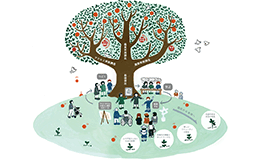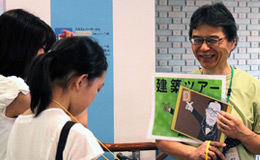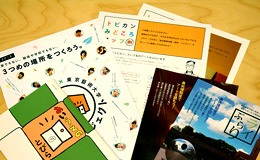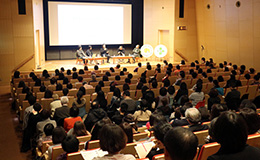




とびらプロジェクトに関わる
人々へのインタビューと、
とびラーが取材した藝大生
インタビュー記事を集めました。


2012.05.30
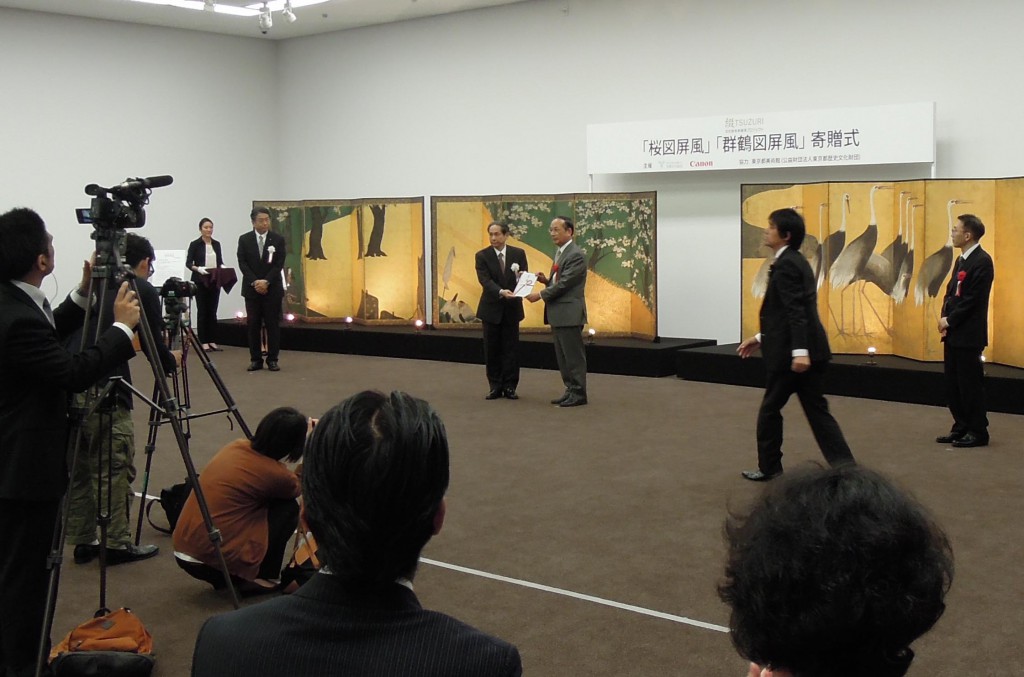
The 5th Art Donation Ceremony of the “Tsuzuri Project” (Cultural Heritage Inheritance Project) was held. The “Tsuzuri Project” is a social contribution activity that the Kyoto Culture Association and Canon Inc. promote together. This time, a pair of high-definition replicas of 6 panel folding screens was donated to the Tokyo Metropolitan Museum. They are high-definition copies of the Sakura-zu Byobu, meaning “cherry blossom design folding screen” (by Sotaro Tawaraya, one of the collection of the Freer Gallery of Art, Smithsonian Institution, Washington, DC) and Gunkaku-zu Byobu, meaning “flock of cranes design folding screen” (by Kourin Ogata, also the collection of the Freer Gallery of Art, Smithsonian Institution, Washington, DC).
The two reproduction pairs of the folding screens were closely comparable to the original and done so beautifully from the fusion of the advanced digital technology of Canon and the artisanship of Kyoto’s traditional crafts history. In the future, we plan to use the donated folding screens centering on art communication projects at places such as practical art viewing education and various workshops.
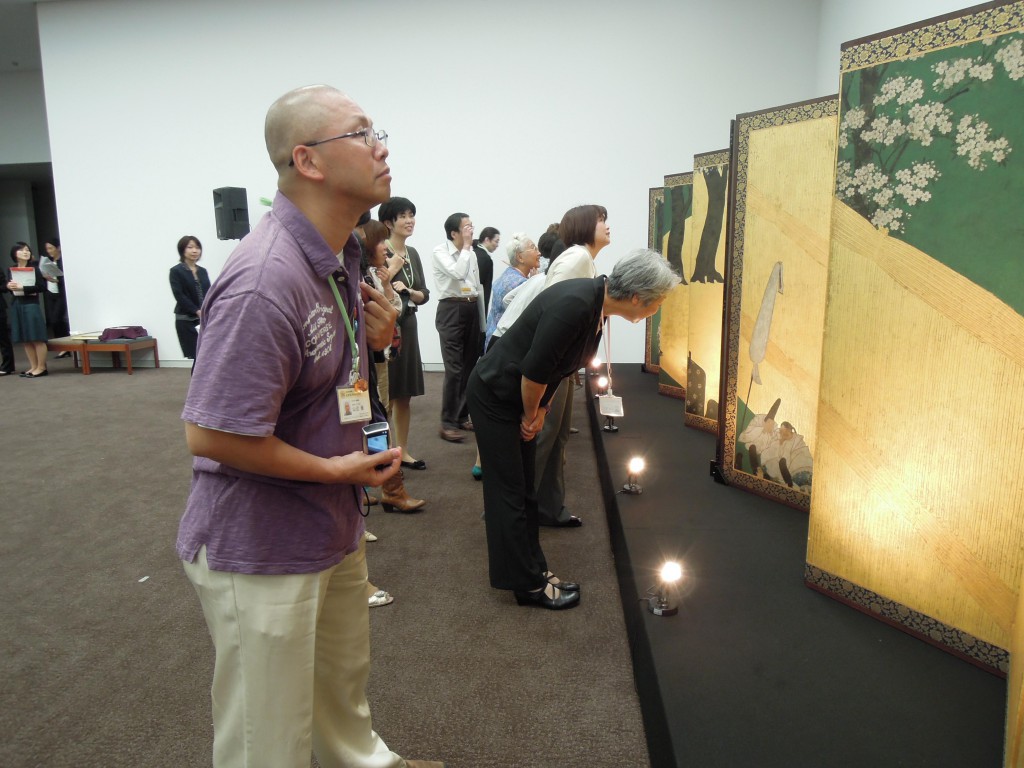
Many TOBIRA candidates (hereafter: TOBIKOs) also joined the Memorial Ceremony, and took a long and hard look at the folding screens after the Donation Ceremony. One advantage of having a reproduced copy is being able to view them this closely without the need to place them inside a glass case. While keeping the original pieces stored in an environment to prevent degradation, realistically experiencing the pieces’ appeal is the beauty of a high definition copy and the concept of the Tsuzuri Project (Cultural Heritage Inheritance Project). It is possible for people with weak vision to view the screens up close and experience the folding screen’s light in a regular daily living space. It seemed that the TOBIKOs were seriously pondering how to utilize the pair of donated screens in the future while viewing them.
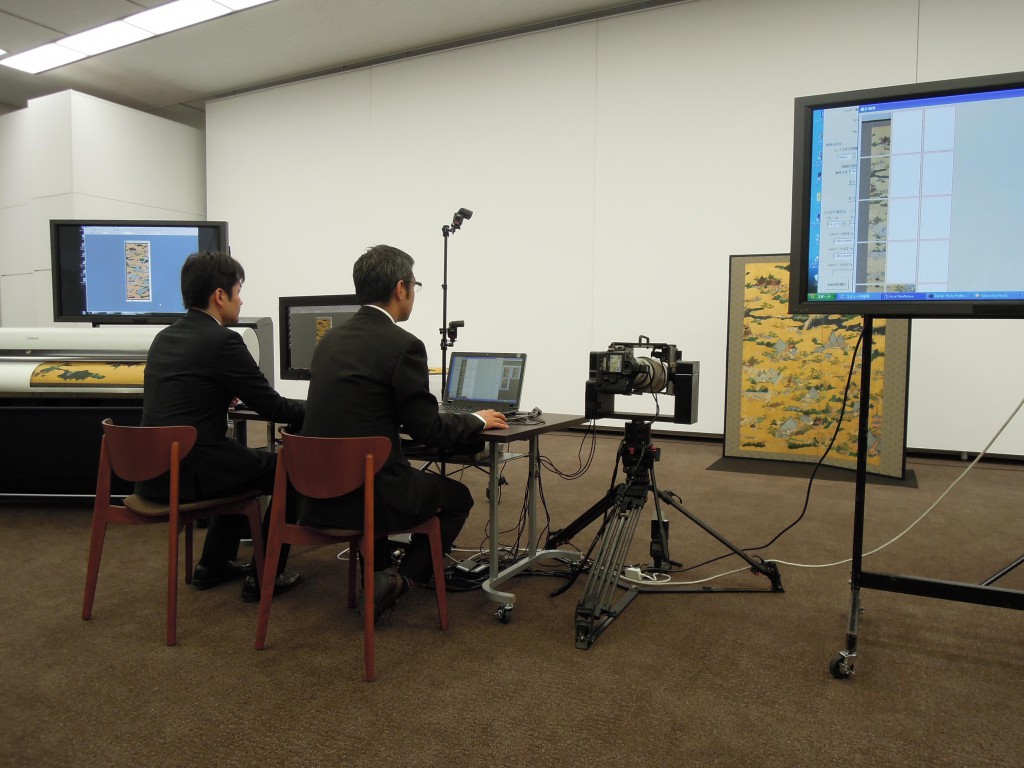
In the exhibition hall, there was also an exhibit regarding the technology used in creating the high-definition copies in addition to the donated pieces. The TOBIKOs got to see a demonstration of high-resolution photography and color output technology by printing out the same exact color as the copied object using Canon’s camera and printer. The paper used for the printout was researched to make sure that the inkjet printer’s color representations will come out while still keeping the impression of the Japanese-style paper used in the folding screens. I could see their thorough dedication.
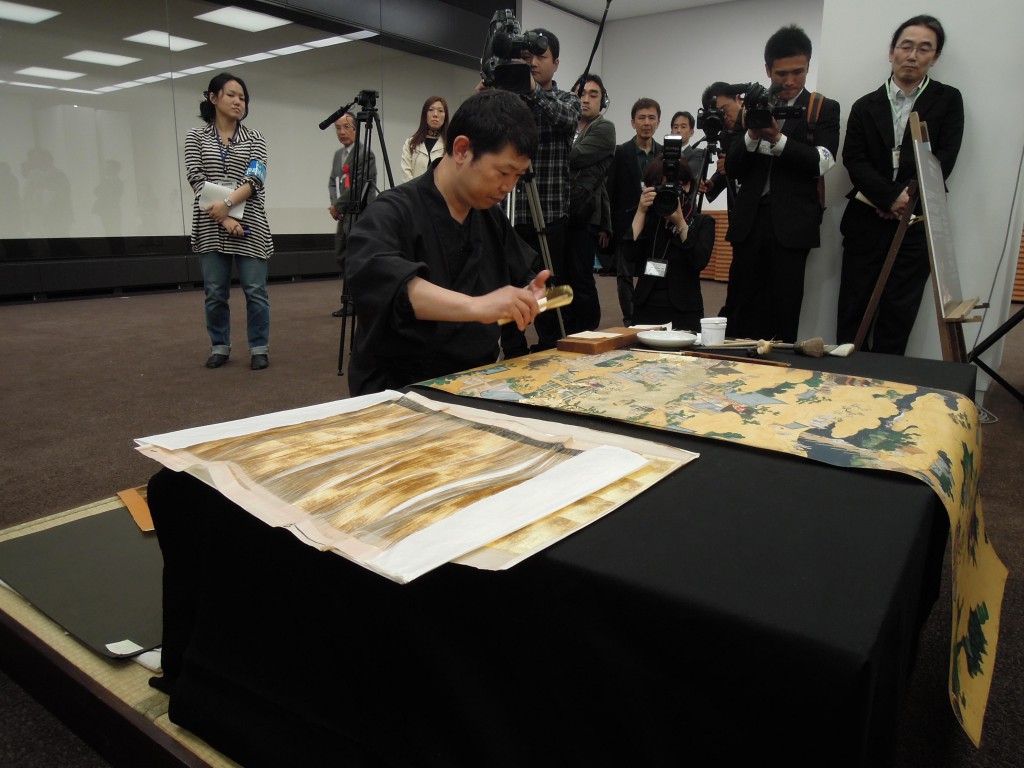
Next, there was a demonstration on how they placed real gold leaf on the picture that was printed out. Making brand new gold leaf look like it has been aged over the years is a technique that can only come from a seasoned and skilled artisan and is therefore brought out in the reproduction. It was truly a moment of collaboration between cutting-edge technology and craftsmanship that has been passed on from generation to generation.
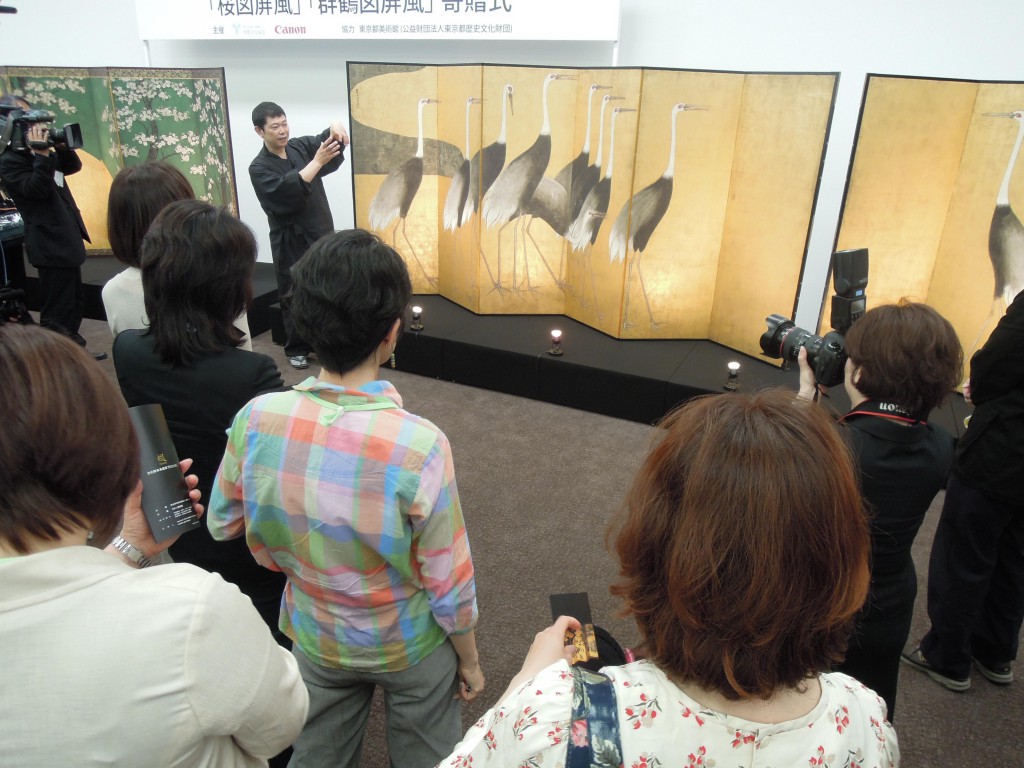
After a demonstration on the placement of the gold leaf, there was an explanation from traditional artisans of issues such as the most difficult aspects of reproducing the folding screens. I was amazed by the craftsmanship used everywhere, such as, needless to say, the scratches and changes from aging in the original, gold leaf color usage and the technique of placing the gold leaf to create shadows to give the surface pattern of the screen contours. Although there was no demonstration at the Memorial Ceremony, after the gold leaf has been inserted, the framing artist’s technique will be added to place the finished picture into the screen, and then these high-definition copies of the folding screens will finally be completed. Even though these pairs are a reproduction of the original, I felt they are amazingly valuable pieces in that so many people poured their research and hard work into it in order to complete the pieces. I am looking forward to planning programs using these screens with the TOBIKOs from now on. (Itō)
2012.05.27
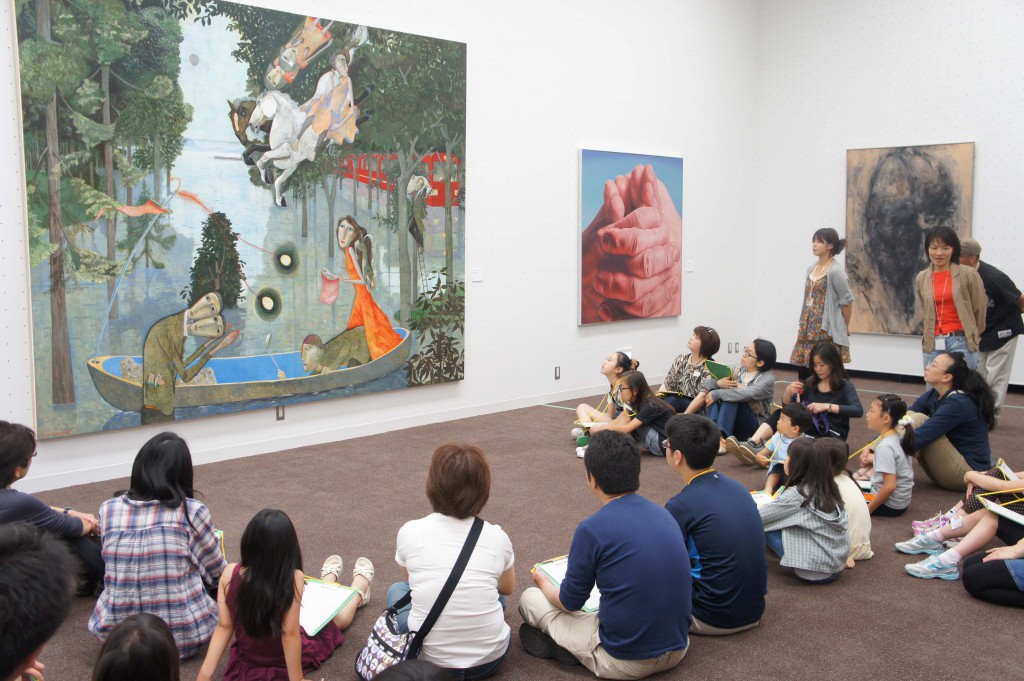
On the last day of the “Public Exhibition of Best Selection Works 2012,” based on things like the color of the paintings and sculptures exhibited, a workshop was offered to create a unique color sample book called the “Variety Color Book.” This project, offered in collaboration by the Tokyo Metropolitan Art Museum and the Bijutsu Shuppan Service Center Co., Ltd. – which runs the TOBI museum shops – was the first workshop to invite a wide range of participants since the opening of the renovated Museum. There were a total of 25 participants, both adults and children, all of whom enjoyed themselves. Of course, the TOBIRA candidates (hereafter: TOBIKOs) firmly took charge of providing support for the workshop.
When the workshop started, everyone immediately headed to the exhibition room, and under Curator Ms. Sawako Inaniwa’s facilitation, the participants viewed a single painting. With everyone talking while viewing the paintings, they were able to discover new things together: pretty colors are hidden in unexpected places and they felt the messages embedded in the colors.
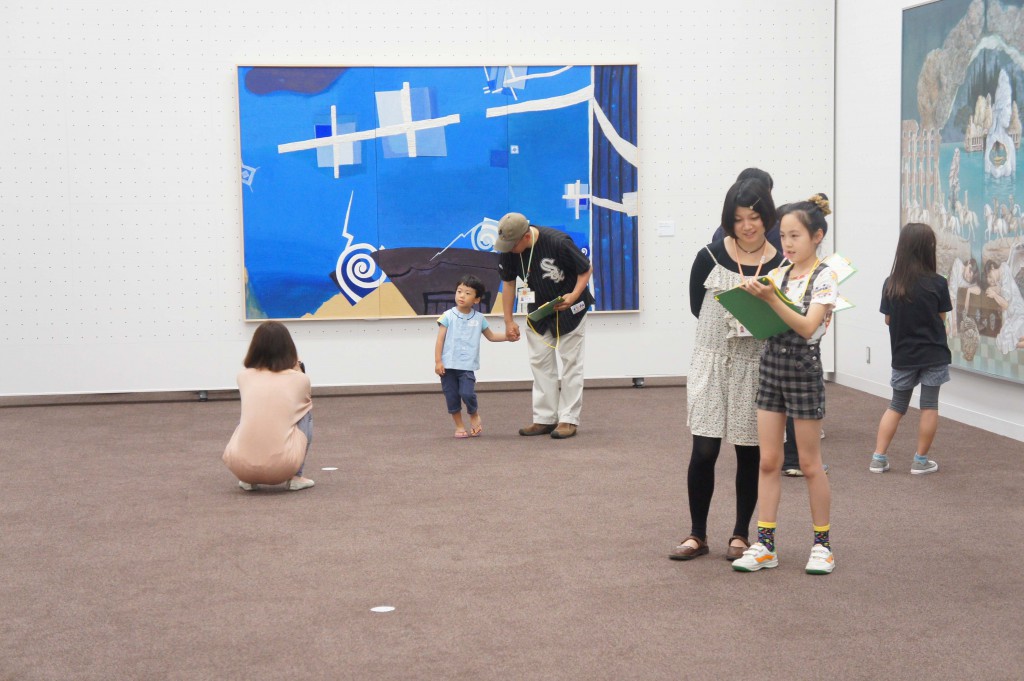
Once everyone got the hang of art viewing, the TOBIKOs and participants divided themselves into small groups of approximately three people each and looked for their favorite painting. The “Public Exhibition Best Selection Works 2012” features 27 groups that are especially diligently active among numerous public organizations, and only artists from each organization that received recommendations are exhibited. This is a public organization all-star exhibition, so to speak. Various expressions like Japanese paintings, oil paintings, watercolor, crafts and sculptures filled the exhibition room.
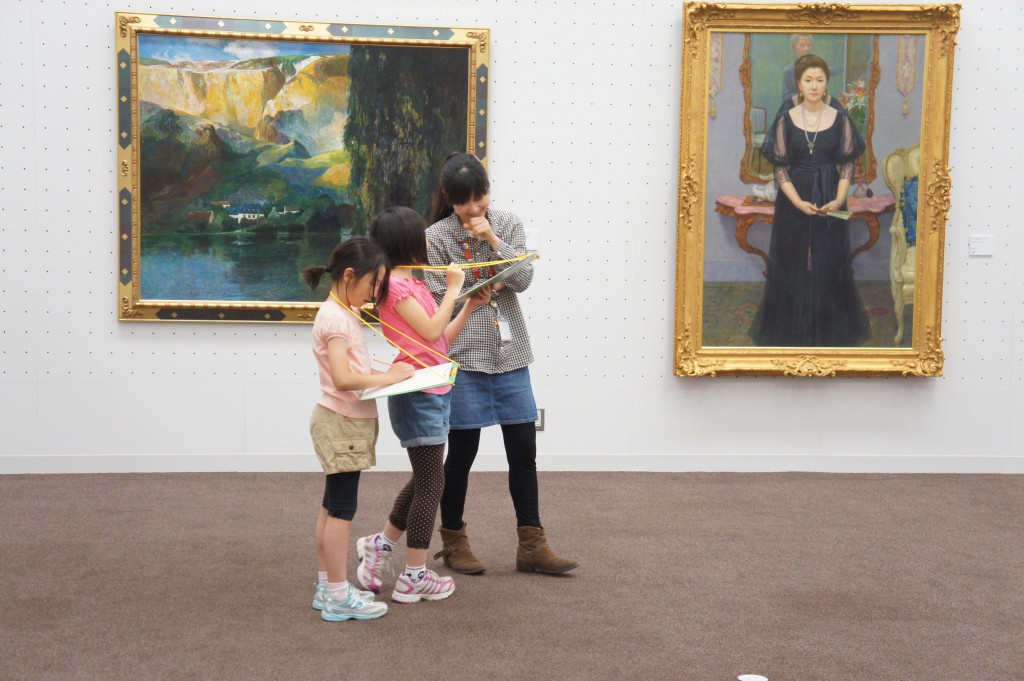
While speaking about various things with the TOBIKO, participants picked two favorite pieces and closely viewed them. The TOBIKOs seemed to be having fun as well.
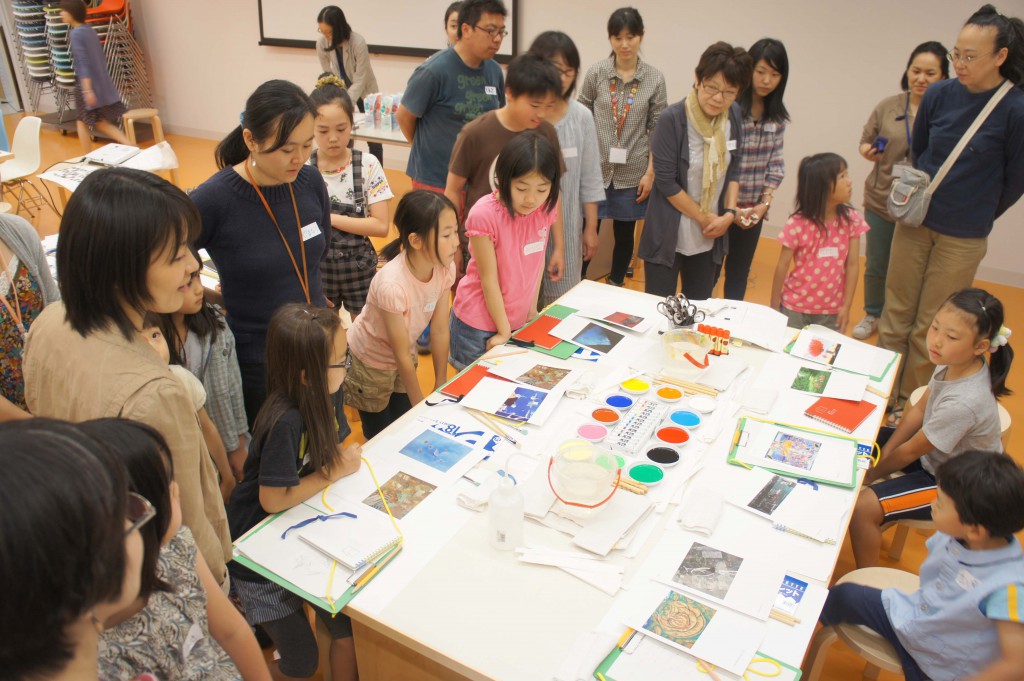
Once they found their favorite paintings, everyone gathered in the art study room and presented their favorite pieces using the evaluation card. Various paintings were lined up on a table.
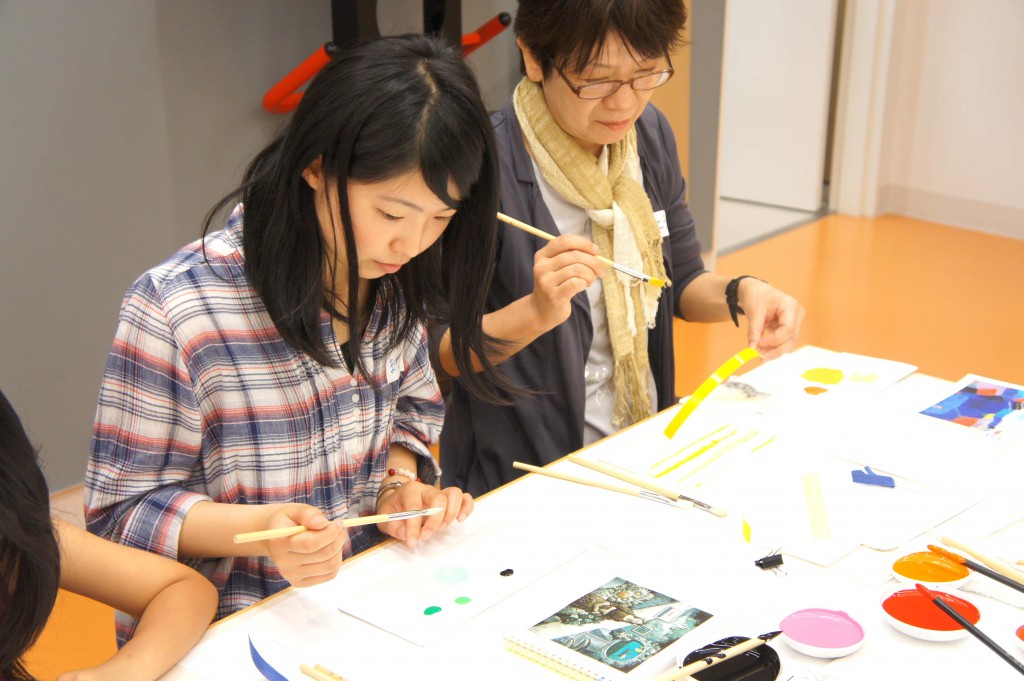
After the presentations, everyone created the colors present in their favorite paintings by combining paints. They carefully mixed the colors in order to make the color close to the striking colors in the paintings. Participants made five colors from each painting. The newly-made colors were painted carefully on separate strips of paper.
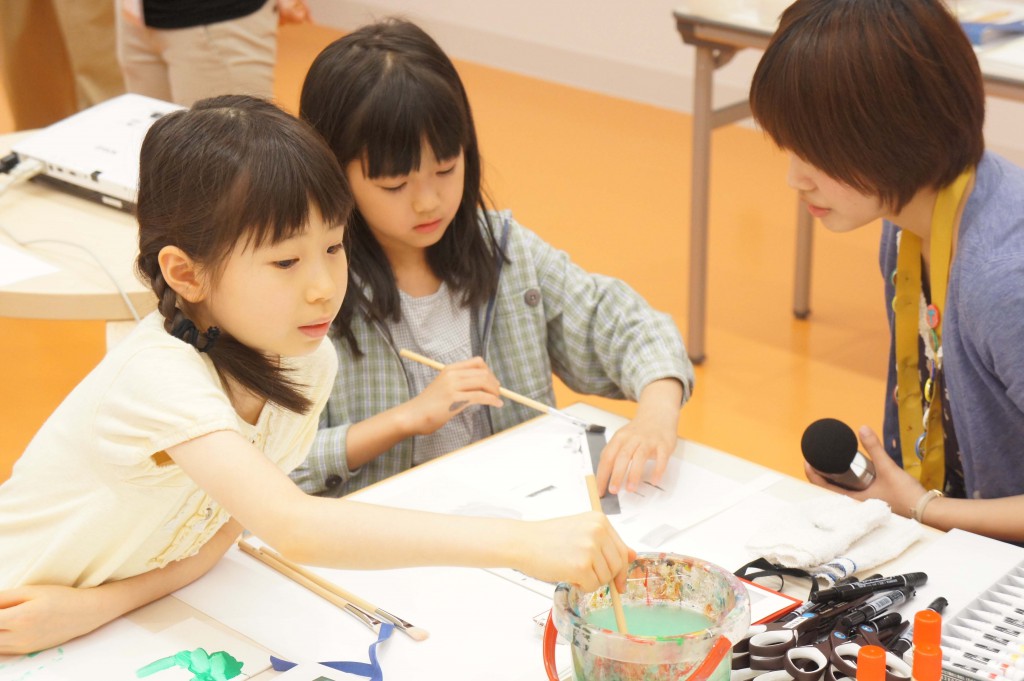
The two paintings generated a total of 10 color strips. Next, the participants cut the painted color strips with scissors and made color pieces. The sizes and shapes, etc. of the color pieces were made with the painting as a hint – A color that was used in a large area would be a large square piece, a color that was seen only as a glance would be a tiny triangle, and so on.
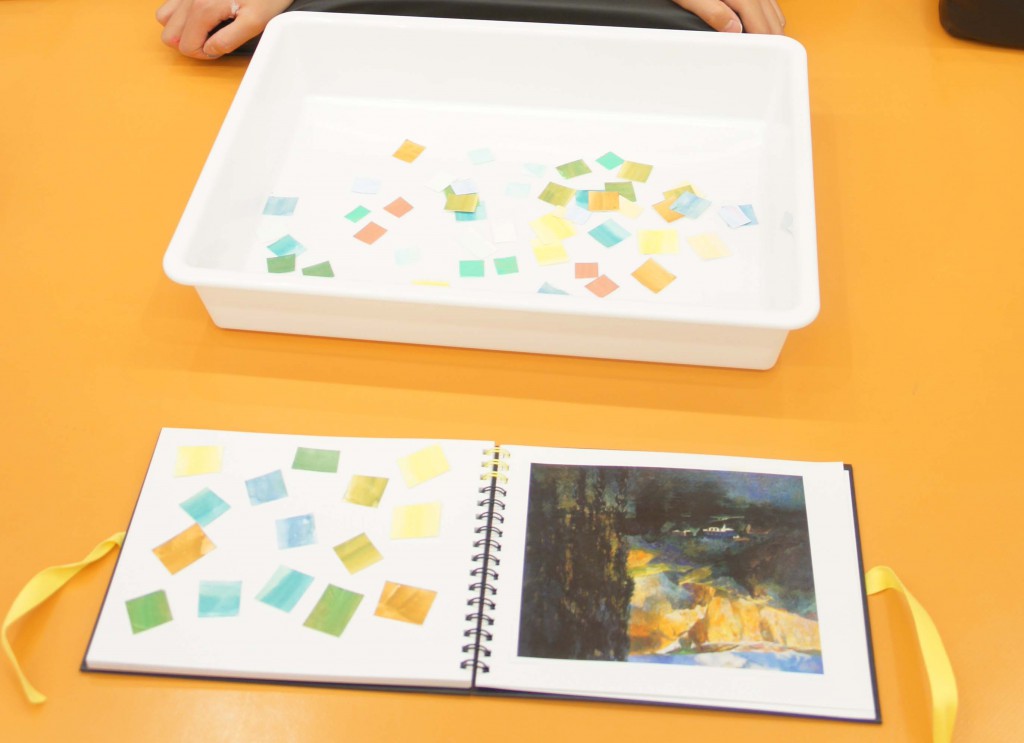
Finally, participants created a color sample book with the color pieces they had made. All of them glued a copy of their favorite painting into a sketch book and placed the color pieces created based on the painting right next to it. They re-organized the colors extracted from the original painting, and it created a different flavor. Maybe everyone felt their favorite paintings more deeply by thinking about the colors hands-on, rearranging the placement of colors and experiencing the effects adjacent colors create.
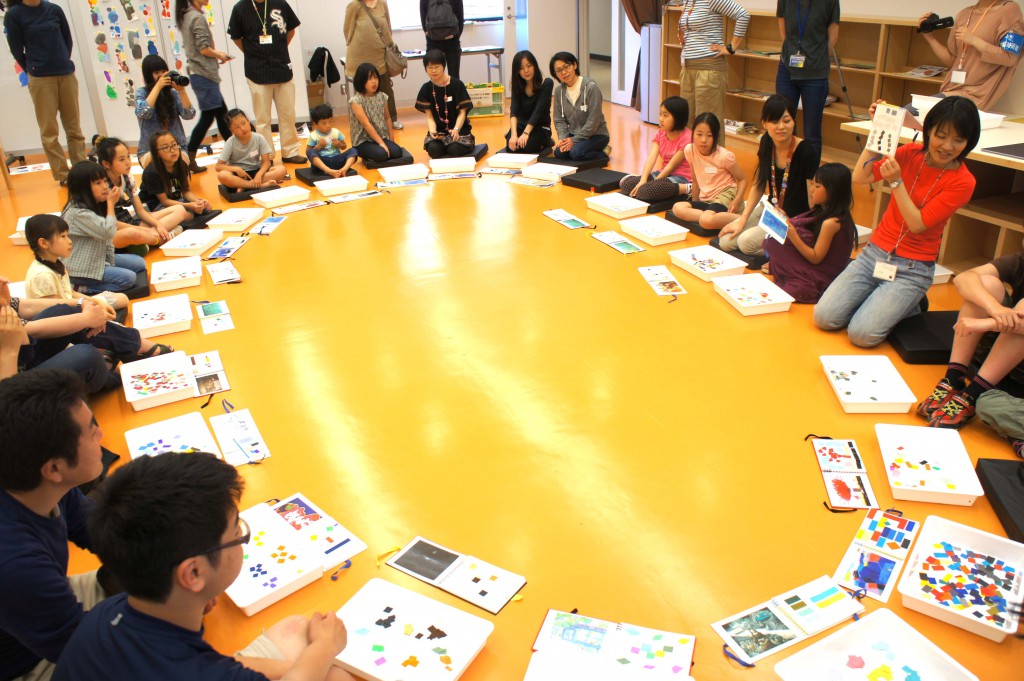
Everyone made their own color sample book. Of course the color sample books looked beautiful, but even the inside of the tray with the leftover color pieces inside looked quite pretty as well.
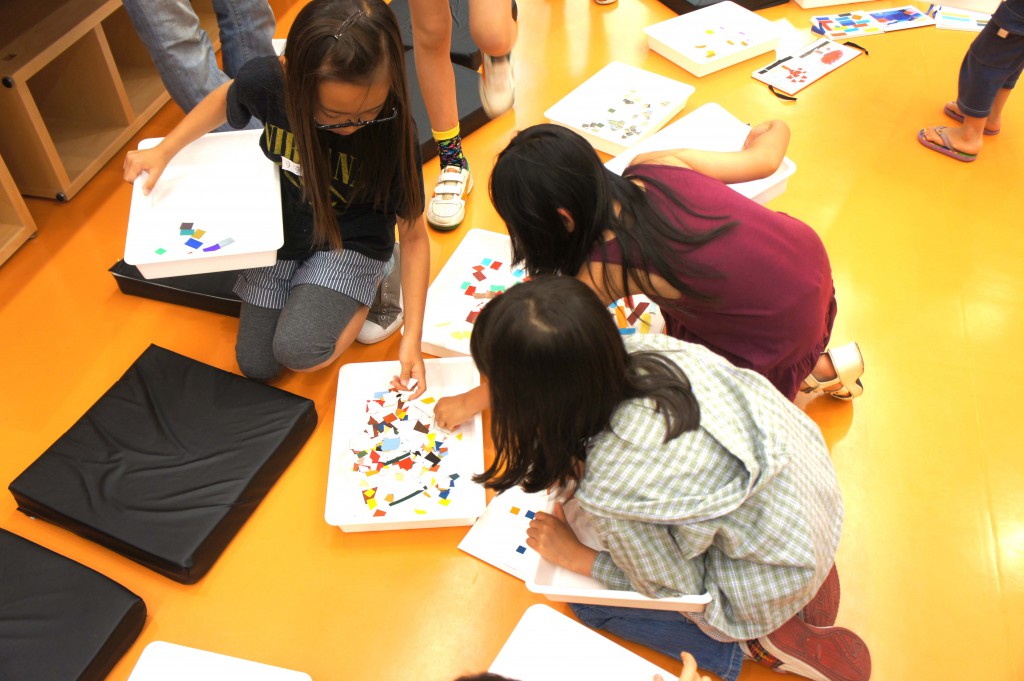
At the end, everyone exchanged the leftover color pieces, and participants took them home as a souvenir. It would be great if many people put together the color pieces taken from their favorite painting and created a different painting in a sketchbook. The paint used today was provided by Turner Colour Works Ltd. Thank you very much! (Itō)
2012.05.26
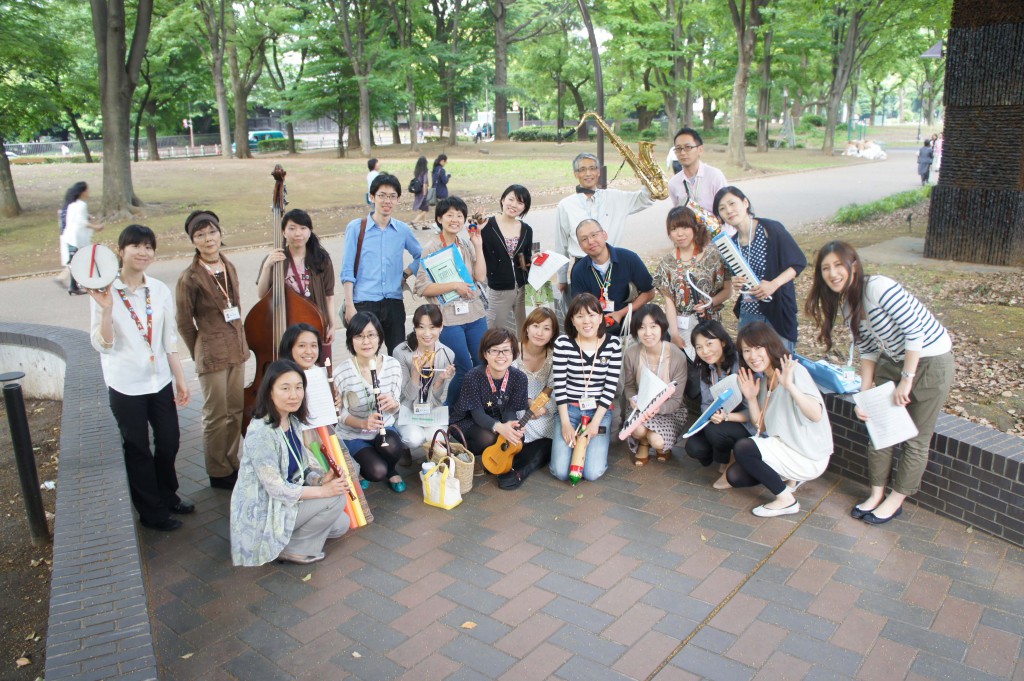
The TOBIRA Band, which came up in the previous “Thinking about TOBIRA Communication Design,” has finally started, with 20 people answering the call. This is great! There is even a saxophonist, a contrabassist, and even a ukulele player. The first practice was held after the 4th Foundation Course. Since the weather was good, they performed right over in Ueno Park. I thought it was amazing that everyone could perform at sight. The NHK song “Metropolitan Art Museum” was their theme song for the meantime (laugh). At any rate, the Tokyo Metropolitan Art Museum is a Tokyo metropolitan museum. While they were practicing, an old woman walking a dog called out to them. Come to think of it, this was the TOBIRA’s first activity in the area.
Music is needed for art communication. The TOBIRA Band isn’t just a group of people performing songs. I wish for them to be a group that moves the hearts of all involved in the TOBI Gateway Project through music. Also, I really look forward to this energy being the driving force connecting the Museum to the region, society and others. (Itō)
2012.05.26
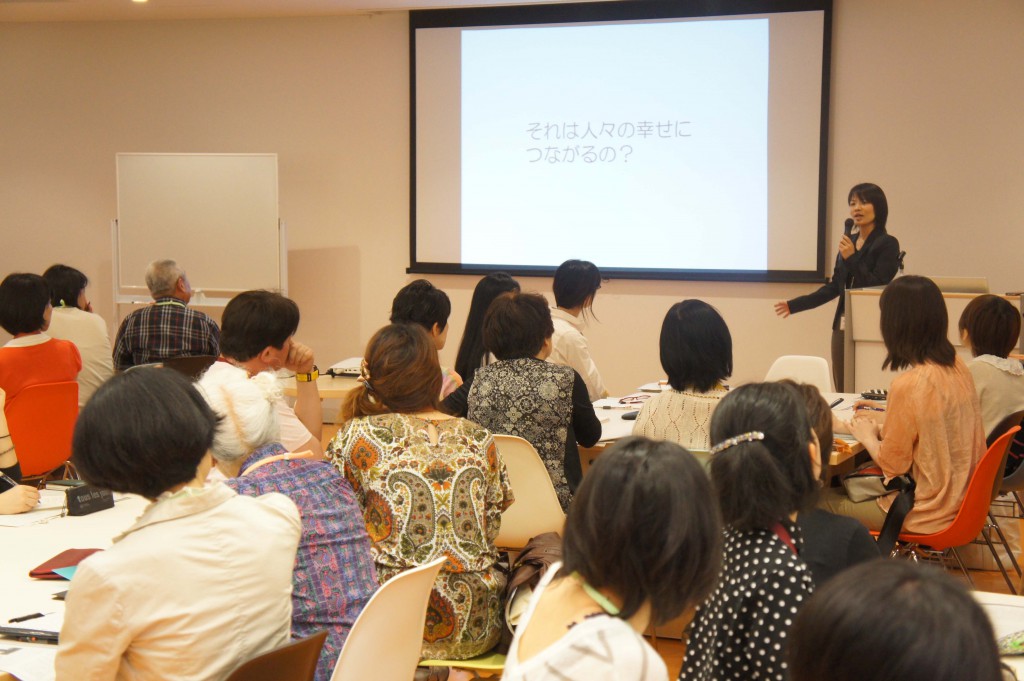
The 4th Session of the Foundation Course was called “Thinking about Creating a Learning Environment.” The morning instructors were Ms. Sawako Inaniwa, a curator and Chief for Education and Public Programs at the Tokyo Metropolitan Art Museum, and Mr. Hiroshi Oguchi, an advisor to the Seiji Togo Memorial Sompo Japan Museum of Art. At first, Ms. Inaniwa gave a lecture about connecting museum visitors with works of art, including her personal experience prior to becoming a curator and the things she had done in that role. She also introduced images and other materials from an event offered at the Museum of Modern Art, Kamakura & Hayama called “Statues of Kamakura.” (This was a short documentary in which junior high school students went through a thinking process by viewing paintings.) Its purpose was to suggest and practically apply the Museum as a space to have a conversation with oneself, rather than considering it merely a place to study and learn about culture.
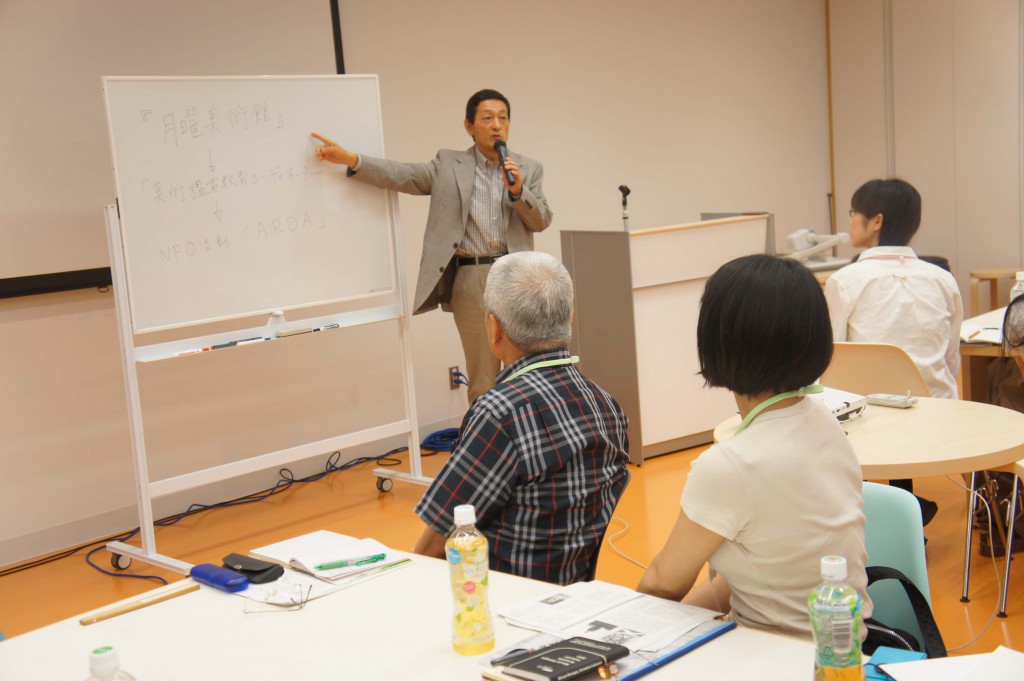
The second half of the morning session was a lecture by Mr. Oguchi. Based on his hands-on experience teaching art viewing around the Seiji Togo Museum in Shinjuku Ward, he pointed out the operational difficulties of introducing art viewing education utilizing museums into school curriculum (Examples include trips between the school and museum during class time and safety management outside of the school). While he pointed out these difficulties, he talked about topics such as the results he hopes to see in the TOBI Gateway Project regarding the school collaboration program. He also touched on the content of art viewing education through conversation offered at the Seiji Togo Museum, and we got to hear comparisons between common art viewing methods and conversational environment methods.
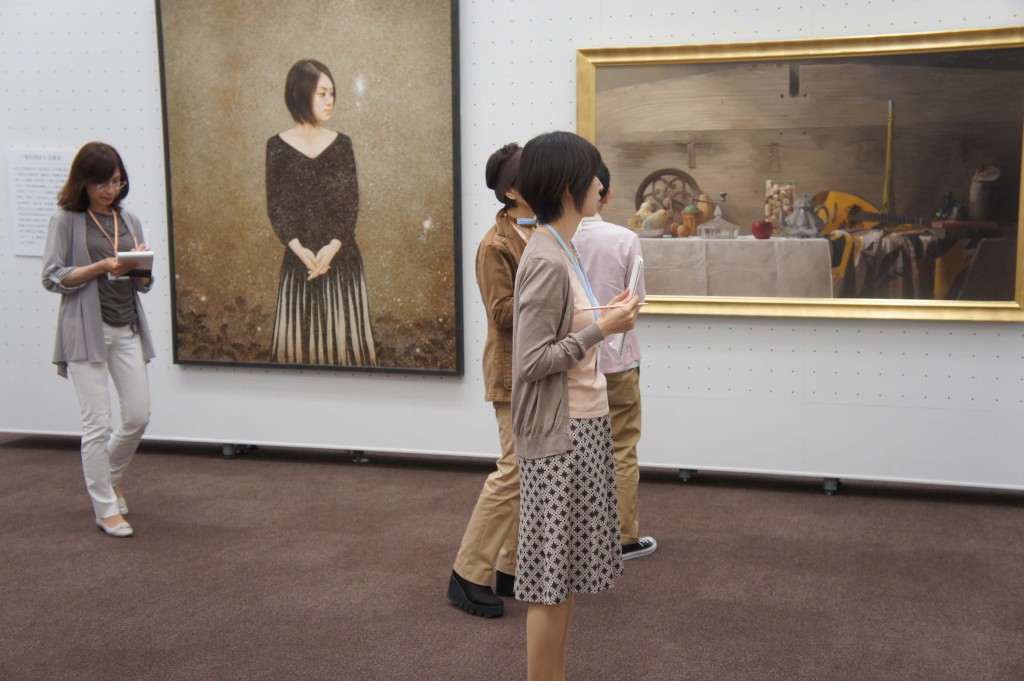
The instructors for the afternoon session of the Foundation Course were Ms. Inaniwa and Ms. Atsuko Takeuchi, also a curator at the Tokyo Metropolitan Museum. They immediately began with the practical application of conversational art viewing education. First, they started by thoroughly observing actual art pieces on their own. Everyone moved to the exhibition room, carefully observed a piece of artwork that caught their attention, and jotted down their own thoughts.
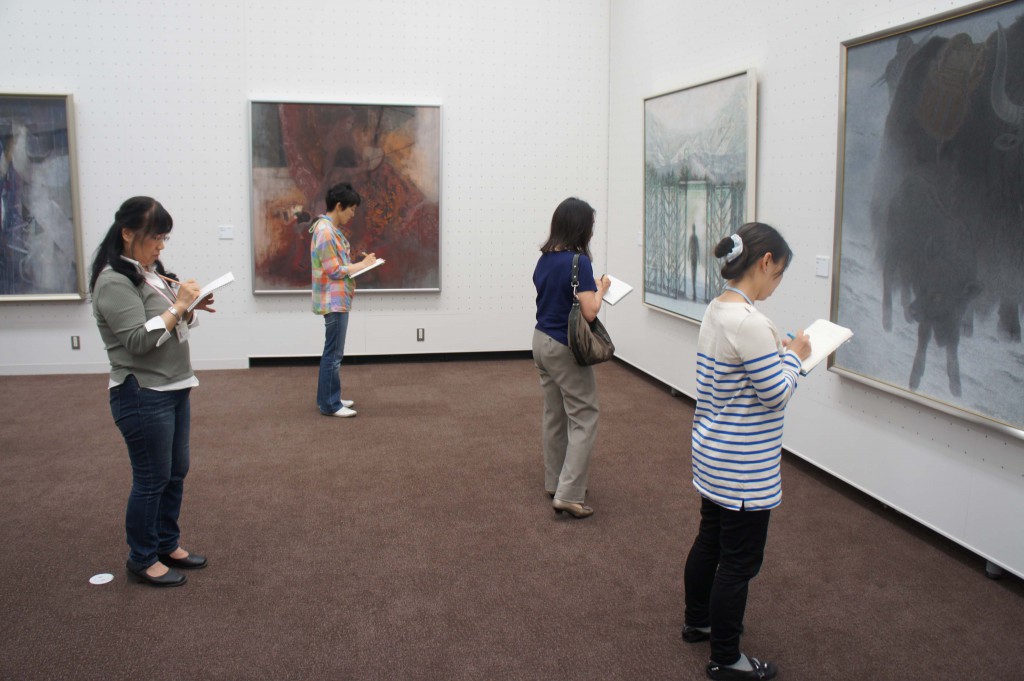
The method of art viewing through conversation started with each individual carefully examining the art piece. When everyone had finished compiling their impressions, they each selected one favorite piece and returned to the art study room.
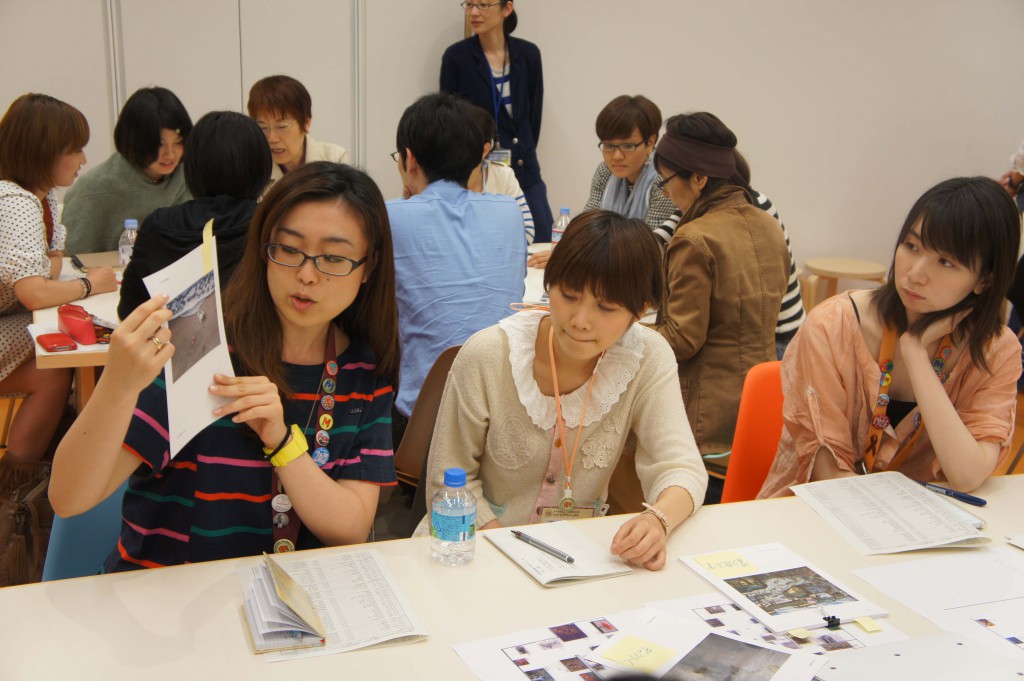
After returning to the art study room, under Ms. Inaniwa’s direction, they all shared their thoughts on the piece they found most intriguing with one another other using art works cards.
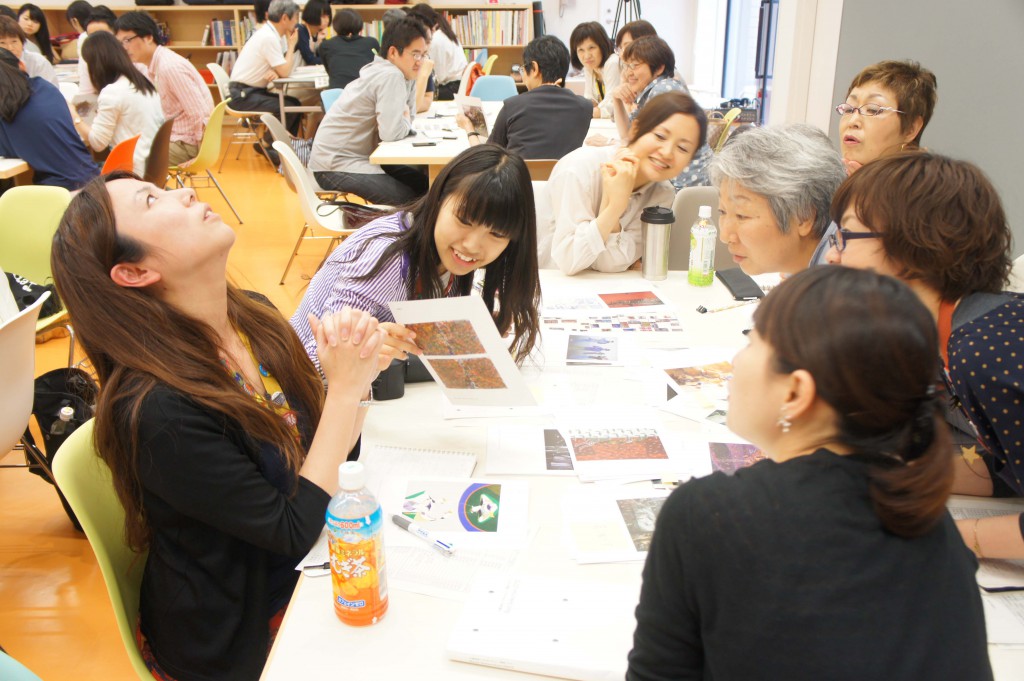
By explaining how they saw and felt about their chosen art pieces, the understanding of others was deepened and we were all able to discern a completely different way to see the painting. In moments like these, mutual understanding is deepened by not just the person speaking about their thoughts on the piece, but also the way of listening among the listeners who hear the thoughts. As you would expect, I felt that the outcome of the 2nd Foundation Course, “The Power of Listening,” was apparent everywhere.
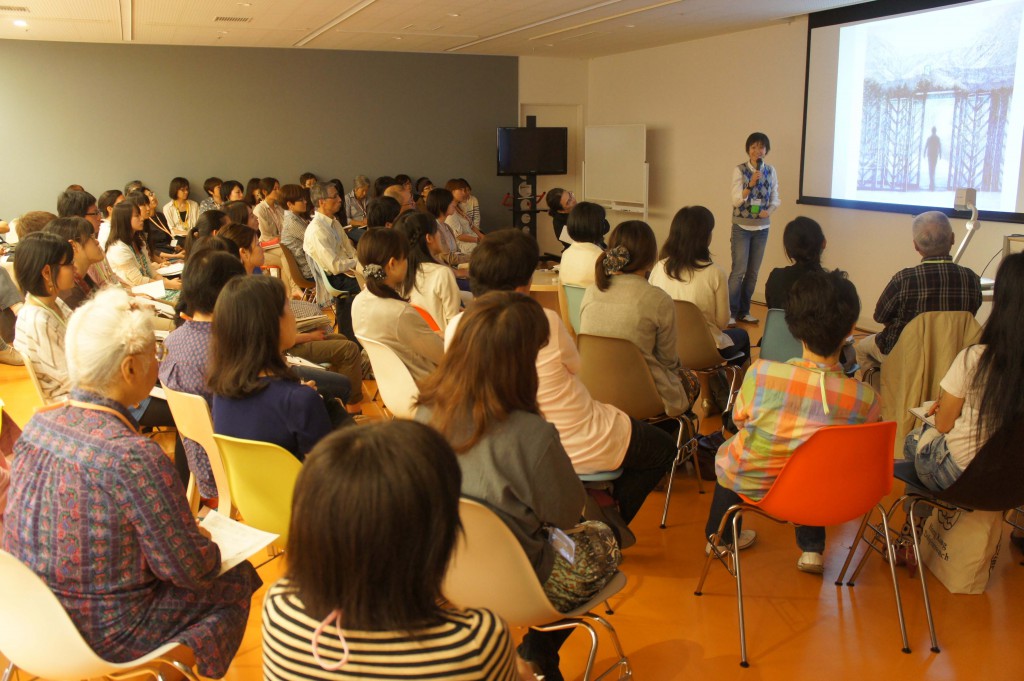
Lastly came Ms. Takeuchi’s demonstration on VTS (Visual Thinking Strategy). This was a facilitation of the art viewing through conversation method that the TOBIRAs have to master for the Practical Application Course. VTS does not require any knowledge of art history when viewing the art. Instead, the facilitator carefully organizes and overlaps the viewers’ various voices that are spun off from the art pieces while bringing out such things as the multiple viewers’ various impressions and discoveries. This does not produce a single, unified understanding of the piece, but takes it to a deeper level in each person. Although a lot of experience and competence is a necessity for the facilitator, I am sure the TOBIRA candidates will do just fine! They are making progress day by day. (Itō)
2012.05.20
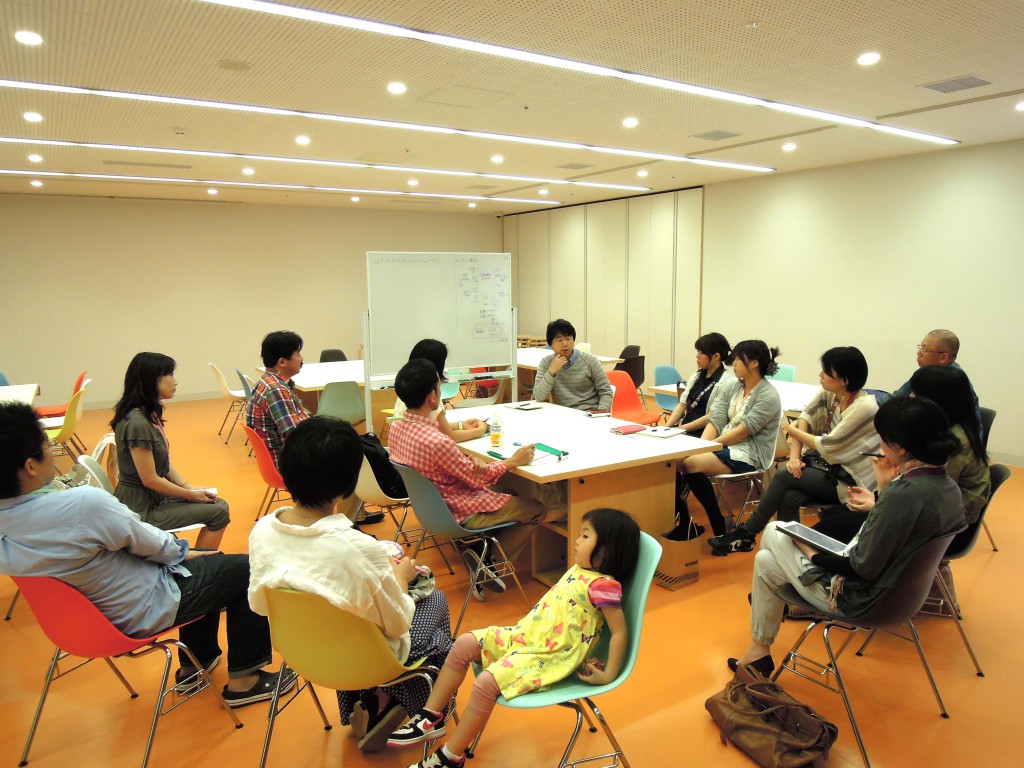
The TOBI Lab on Sunday, May 20th concerned a topic that I (Tatsuya Itō) had called for: “Thinking about TOBIRA Communication Design.” We had the meeting with themes like how we can have smoother communication between more than 100 people, including TOBIRA candidates and staff, and what we should do to make TOBI an even more stimulating place for the candidates. Although a bit presumptuous, I suggested founding a “TOBIRA Band.” I made this suggestion thinking that with this many people, there have to be some who can play instruments. We got quick approval, and the Symphony was founded at once. I hope that the TOBIRA Band will not just be a group of people performing songs, but a group that will move the hearts of everyone involved in the TOBI Gateway Project with their music. Besides that, many opinions were exchanged, from a method of information sharing through e-mail and blogs, etc., to more specific ones like “Once the Foundation Course is done, there is no place for all of the TOBIRA candidates to meet up. We would definitely like to create a place for everyone to get together on a regular basis.” Another idea was promoting analog communication by adding comments to the common topic of conversation with sticky notes on the wall of the art study room. The first half of the Foundation Course has already passed. Aside from basic knowledge for TOBIRA candidates, horizontal networking will also provide an important foundation. (Itō)
2012.05.19
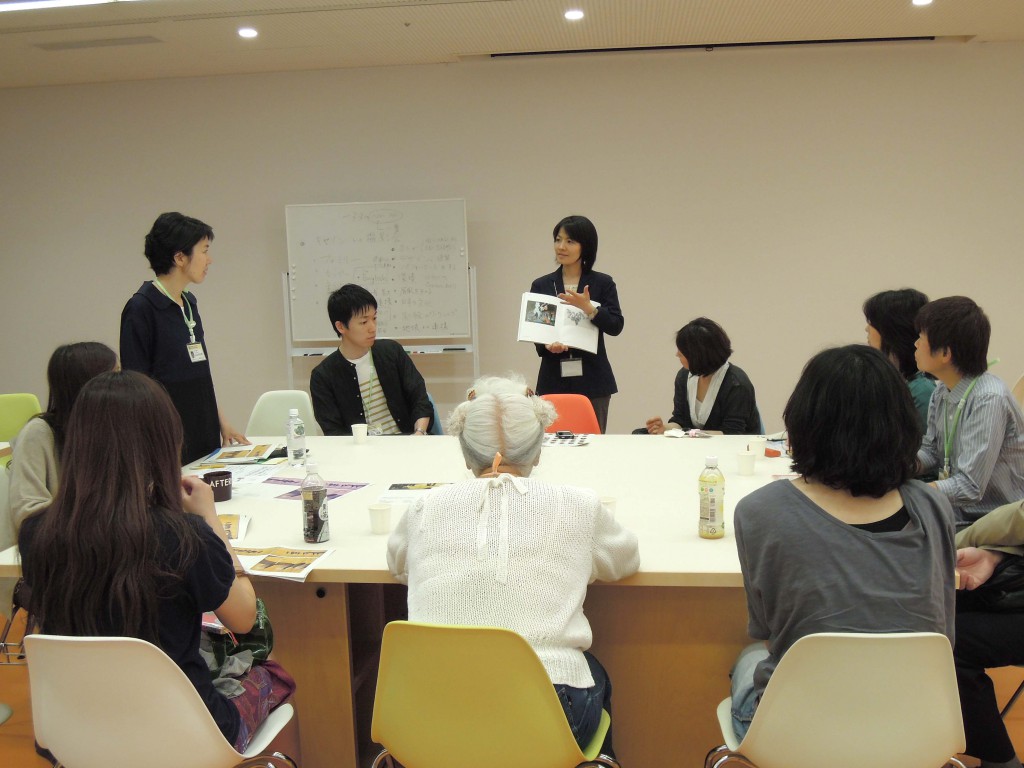
Between the Foundation Courses held every other weekend (Friday, Saturday, and Sunday), there is a seminar day (called “TOBI Lab”) to create gently stimulating activities. The TOBI Lab offered on Saturday, May 19th was a meeting to consider the “Tsuzuri Project” with curator Ms. Sawako Inaniwa as a leader. This is a project featuring high-definition copies of 2 pairs of 6 panel byōbu (Japanese folding screens) that are scheduled to be donated by Canon.
2012.05.12
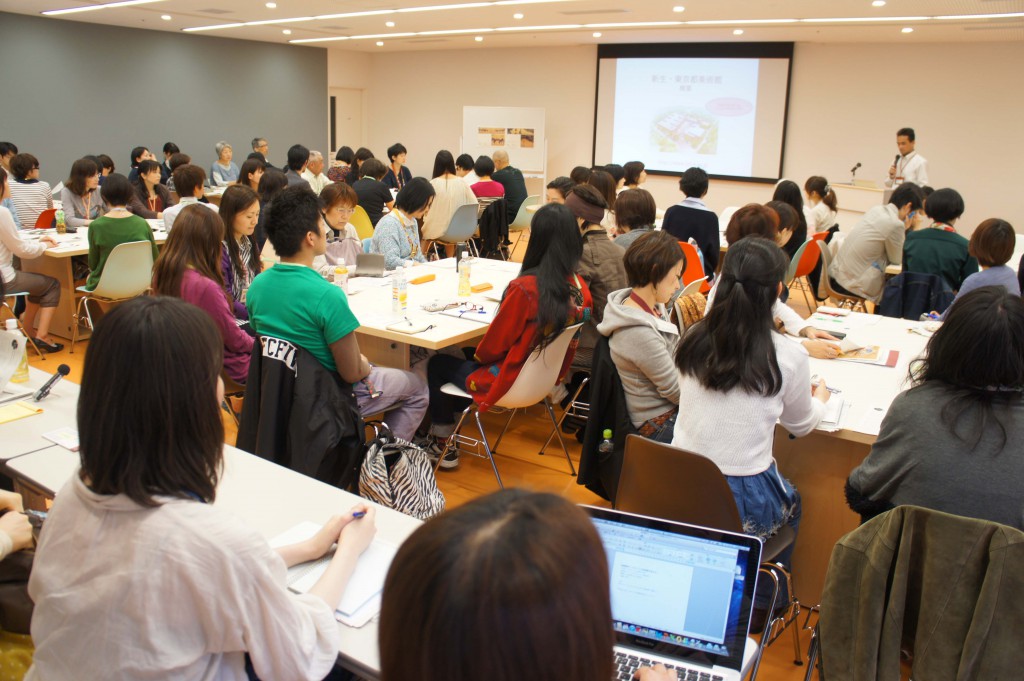
We’ve finally reached the 3rd Foundation Course. Our morning instructor was the curator, Hidehiko Sasaki. We were able to hear the passionate and frank comments from the perspective of a TOBI curator such as, “TOBI is based not on collections, but connections” and “Just using Western art museums as an example does not apply. We have to think of the best way for Japanese art museums.”
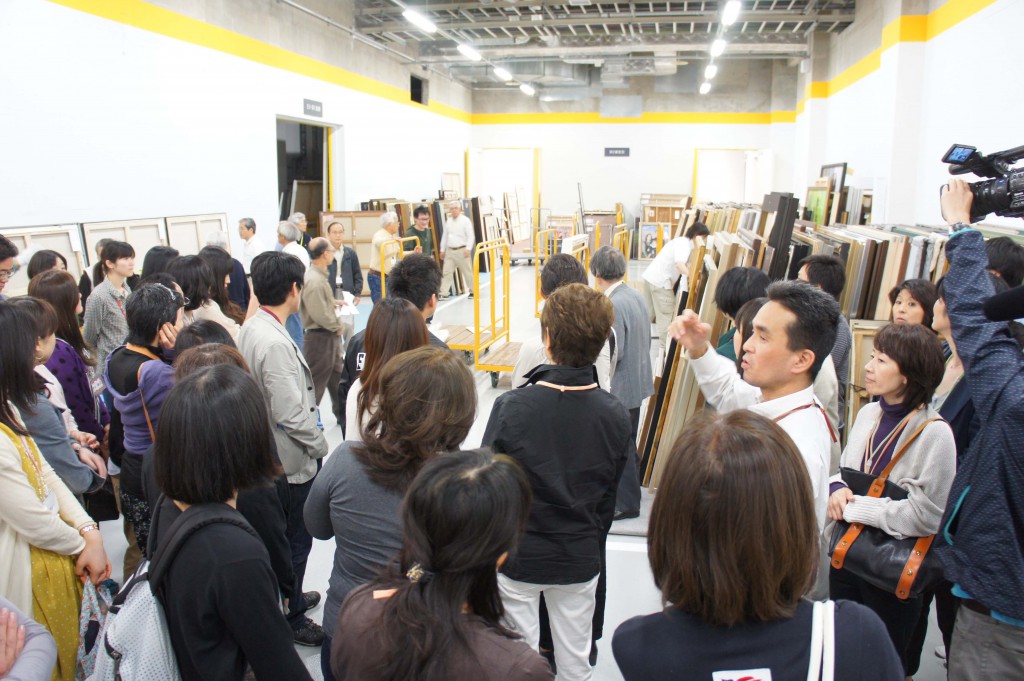
After the lecture, we toured the “back yard” of the Museum. There was an exhibition just being delivered, so we got a behind the scenes tour that you don’t normally get to see.
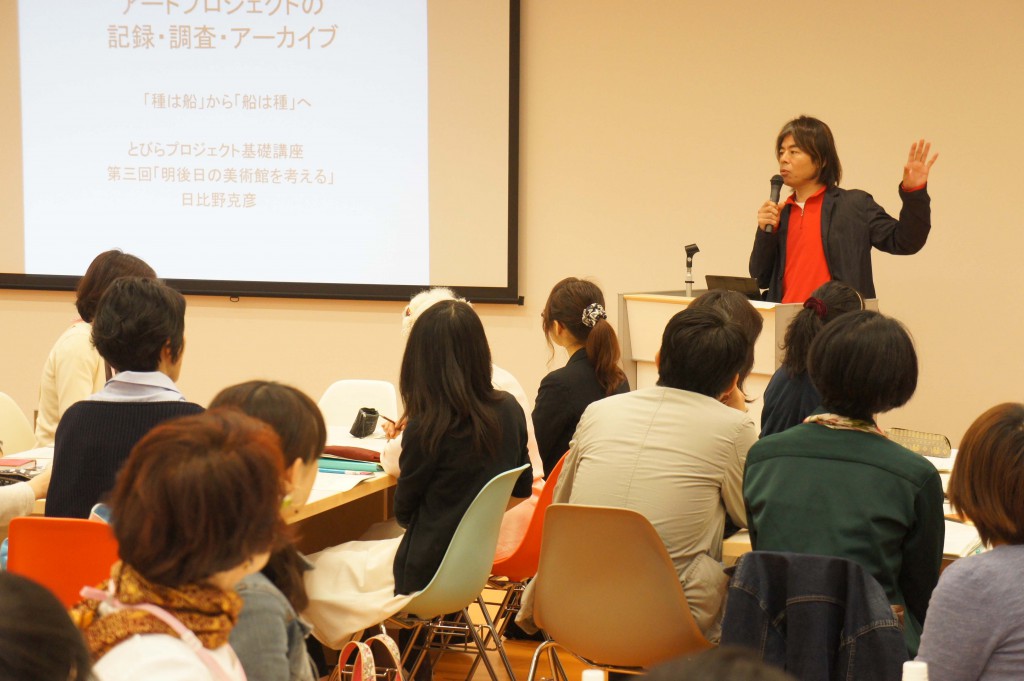
In the afternoon, there was a course by Katsuhiko Hibino titled “Recording, Inspecting and Archiving of Art Projects.” Using the archive project “Ships are Seeds” related to the “Seeds are Ships” project that he is presently undertaking, in the first half Hibino-san discussed the importance of, after recording the art project, highlighting such things as the experiences and memories which emerge from each individual participant that tend to be buried.
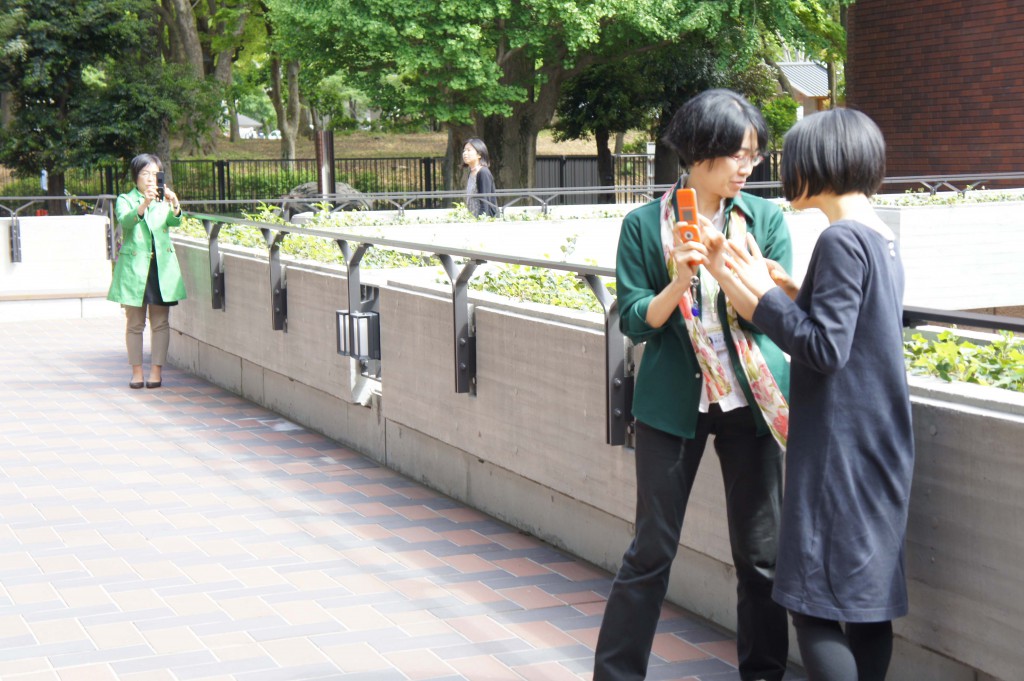
In the second half, based on the lecture, there was a workshop to experience ways to draw out personal experiences and memories and such. The themes from Hibino-san were “while looking at the regular background, we all see things differently.” After taking pictures with a portable camera, through dialogue with others we went about putting into words things like the experiences and memories evoked by one of the pictures. We then promptly went out and began taking pictures around the Museum.
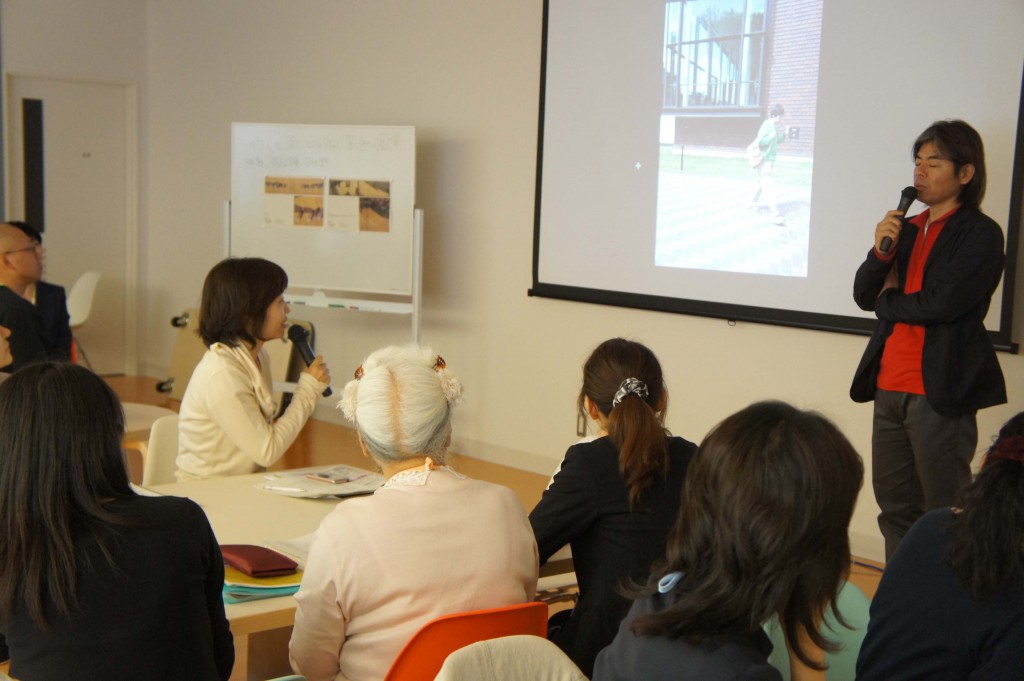
After taking the pictures, we returned to the art study room once again. With Hibino-san facilitating, the TOBIRA candidates spun out words evoked by each of their pictures. Pictures are chances for us to face such issues as our own experiences and memories, and also became an entry way for us to share these things with others. With the Project progressing, it is important for everyone to move forward together. However, even with a common experience, how one feels, thinks and receives it is different for each individual. I felt that giving a voice to these different ways of receiving the experience will make it valuable and further broaden the project. (Itō)
2012.04.28
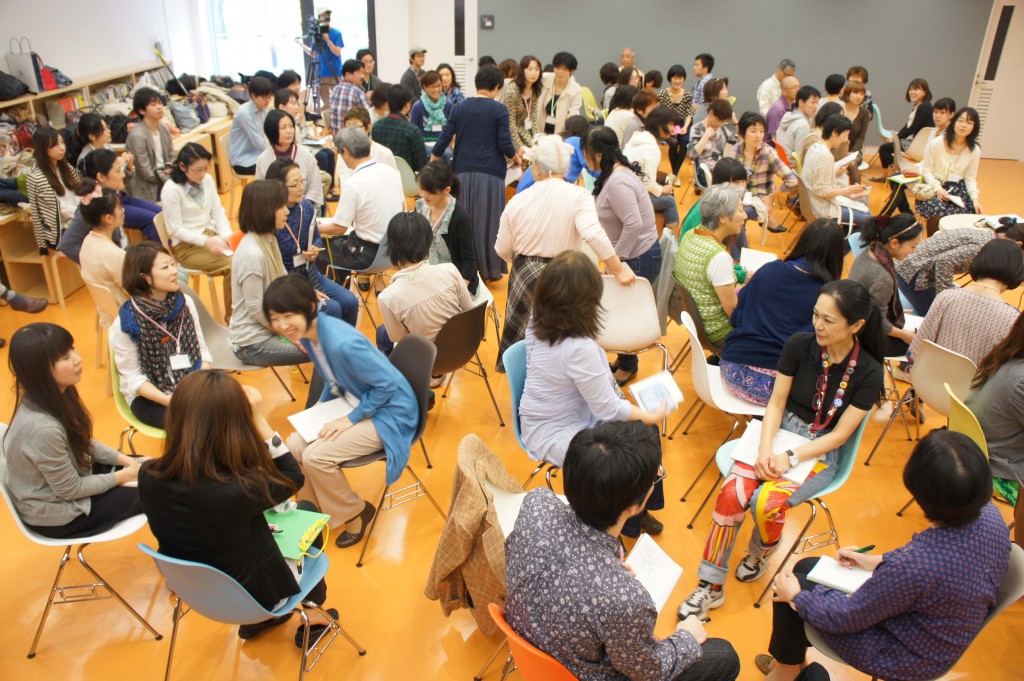
The instructor for the 2nd Foundation Course, titled “The Power of Listening,” was Mr. Yoshiaki Nishimura. The agenda he prepared for us is below.
・What does it mean to “not listen”?
・What does it mean to “listen”? And what results from it?
・Looking toward future of the TOBI Gateway Project (summary)
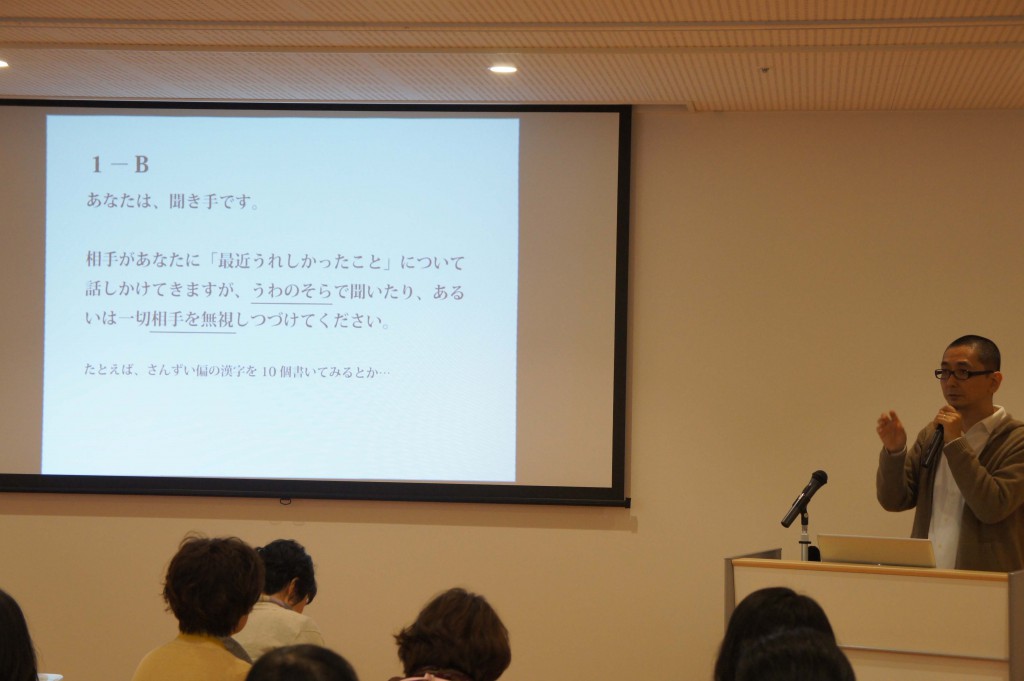
At first, the TOBIRA candidates were paired up and split into roles A and B.
Next, A and B each got directions from Mr. Nishimura, but they did not know the other’s instructions. For A, the instructions were, “Please convey with emotion to B something that recently made you.” For B, the instructions were displayed on a screen secretly from A.
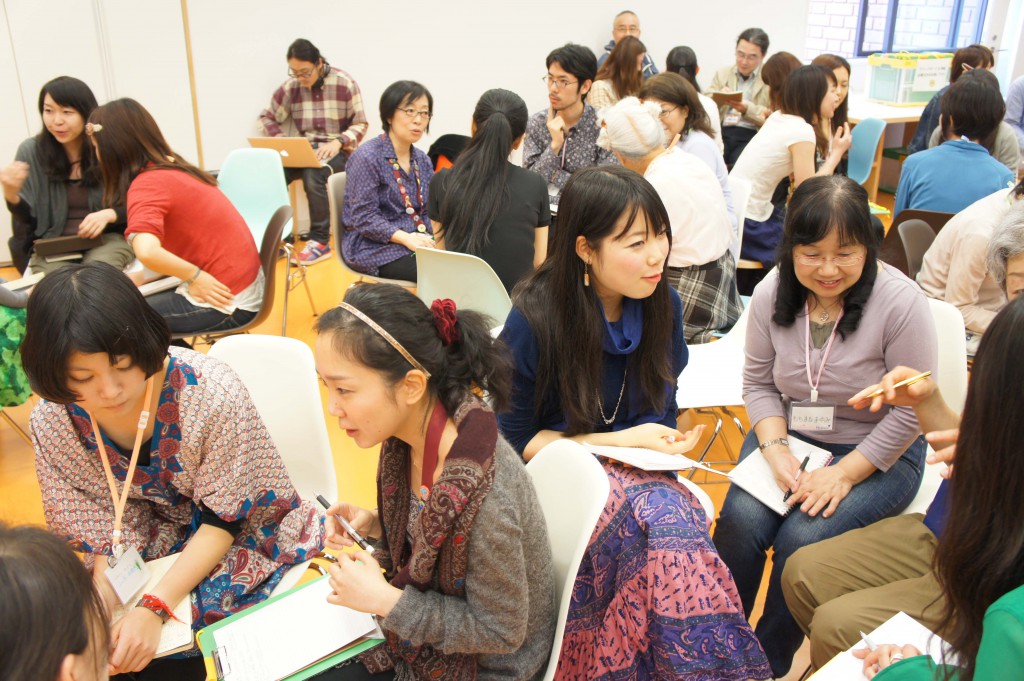
For a few minutes, A tries very hard to tell her story, but B pretends to be concentrating on listening while his mind is somewhere else. Eventually, A becomes less and less able to speak to B. Participants realized that time goes so much slower when trying very hard to talk to a person who is not listening. You would have thought that there is an advantage to being the person who talks (the one who delivers the information), but we noticed that, in reality, the behavior of the listener (the one who receives the information) has a great deal of influence on the speaker.
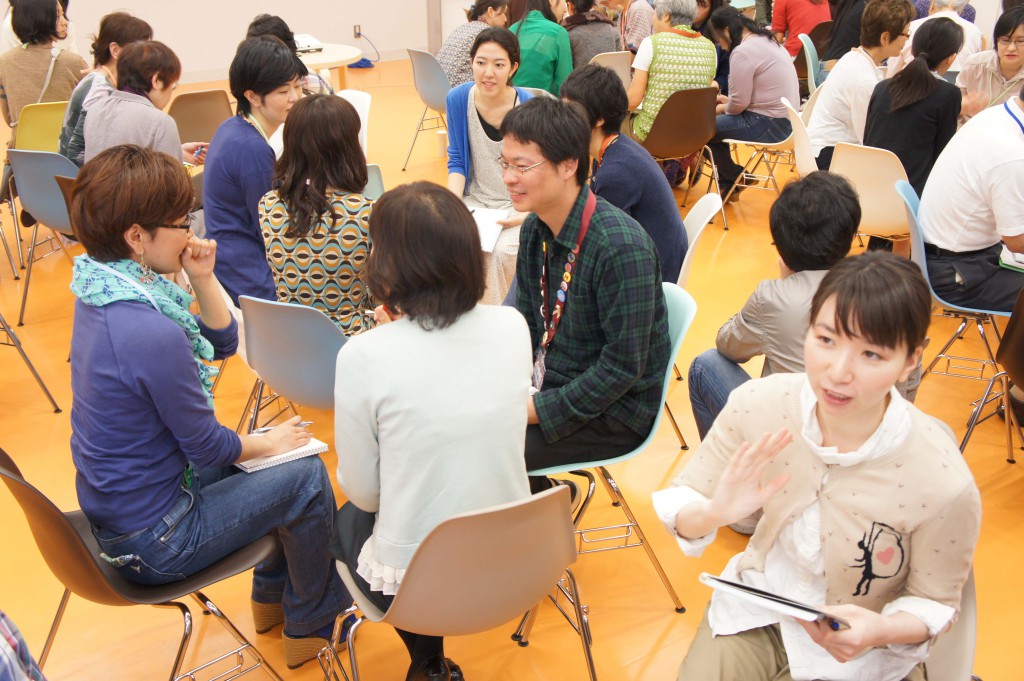
Participants shared their thoughts and feelings on this experience by exchanging opinions in small groups. We swapped out group members several times and continued to practice this scenario. I thought this 4-hour Foundation Course was a good opportunity for the TOBIRA candidates to get to know their fellow members, many of whom were talking to each other for the first time. The power of listening, which enables deepened communication, is truly an important ability for Art Communicators. When we establish relationships where we can precisely draw out, receive and share what the other person is saying, the TOBI Gateway Project will become a more creative place. (Itō)
2012.04.22
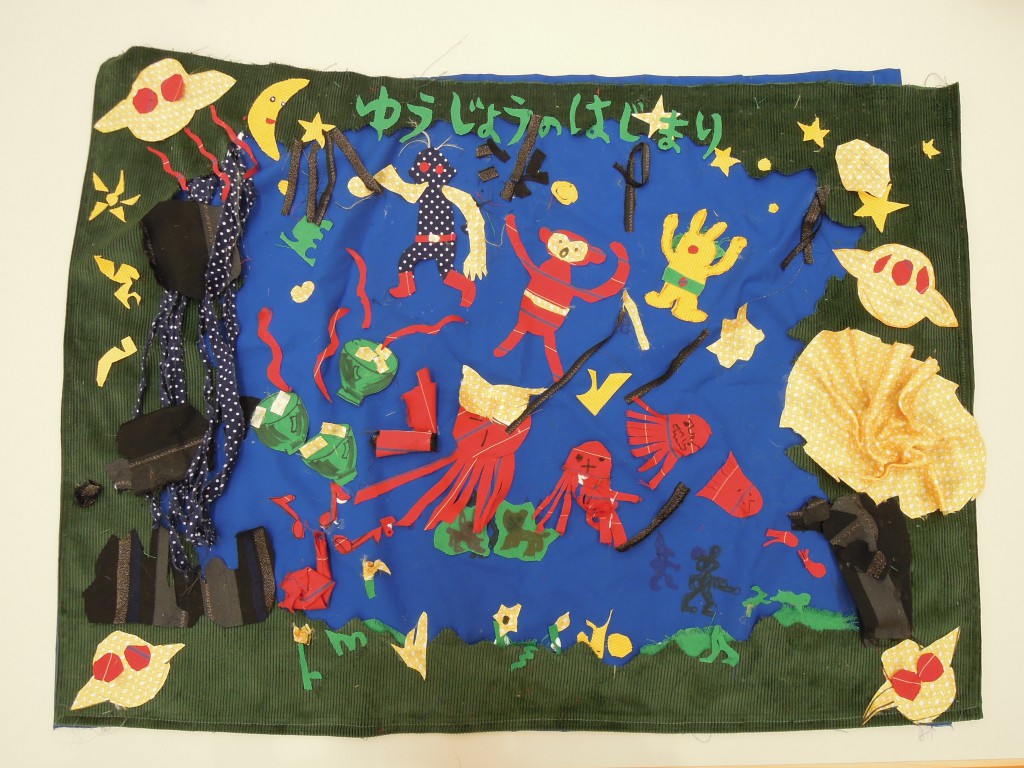
Having successfully completed the Initial Foundation Course and the Renovation Memorial Ceremony, etc., the TOBI Gateway Project is gradually getting on the right track. At the TOBI Lab on April 22, we had Yū Sato, who is enrolled in the Doctorate program at the Tokyo University of the Arts Department of Intermedia Art, come as an instructor to interact with the TOBIRA candidates. Yu Sato’s workshop was structured in a three layer progression: “Single Page Story” → “Single Sheet Flag” → “Single Sheet Tale.” It was a 3-hour long marathon event, but as expected, the TOBIRA candidates handled it well.
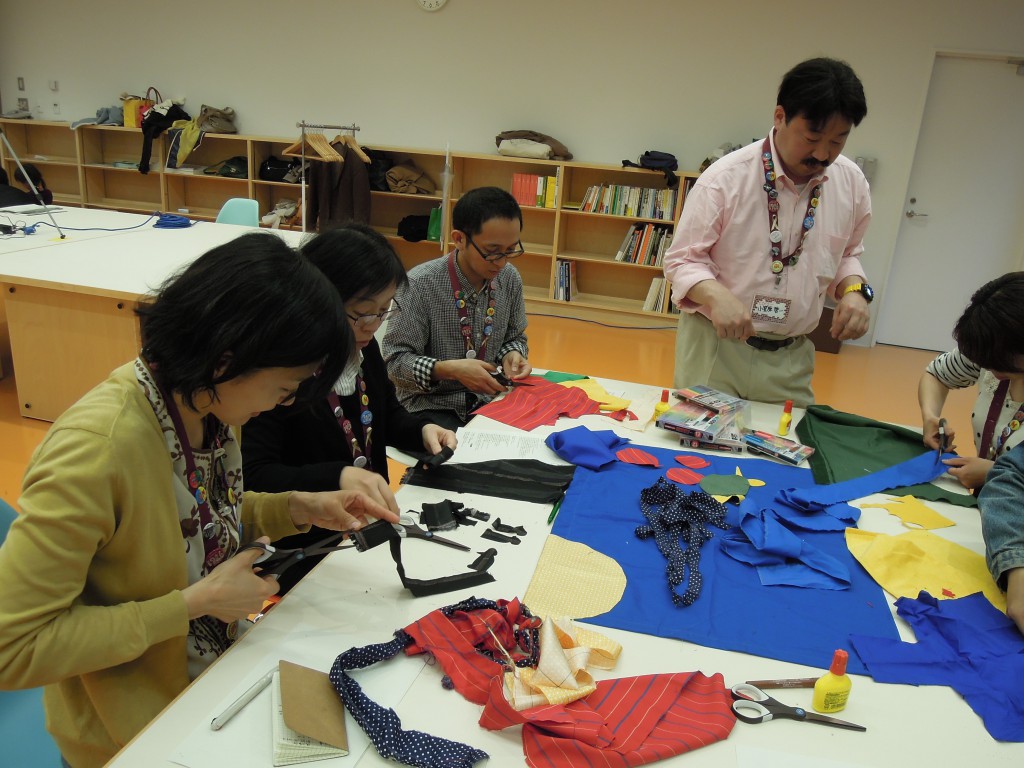
The TOBI Gateway Project is a large organization of over 90 people, making it rather difficult for the TOBIRA candidates to make time to talk to each other in a relaxed environment. For this reason, we created the TOBI Lab to provide a time and place for them to freely use to get to know each other on a deeper level.
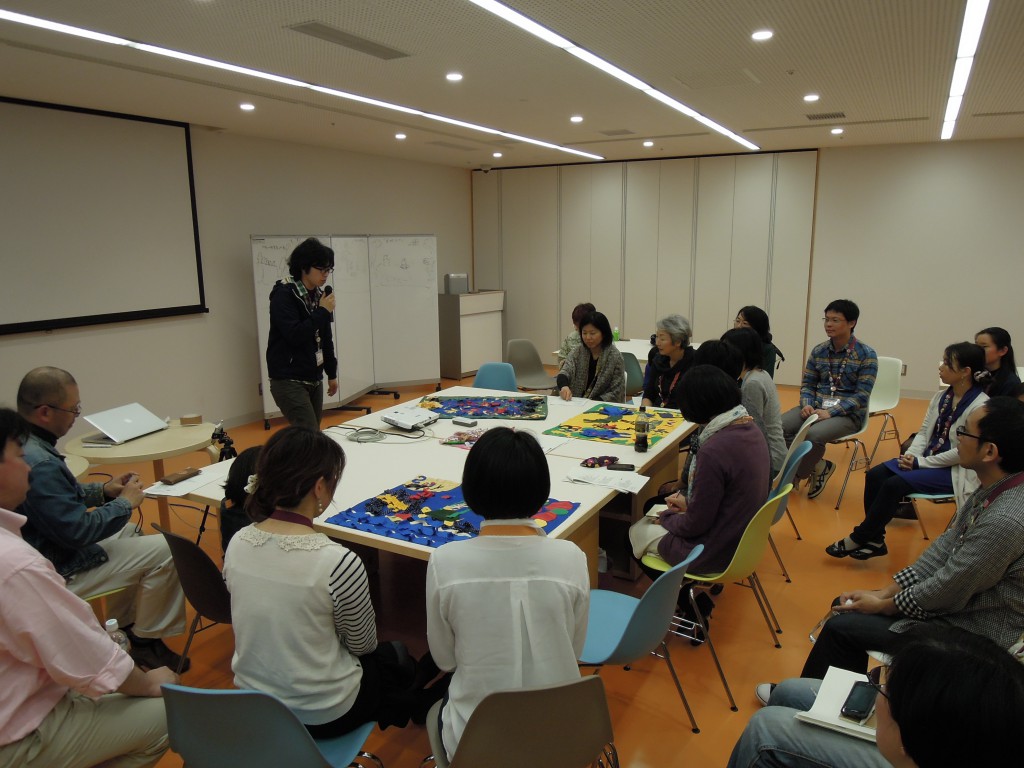
From April to June, the TOBI Lab makes the Art Study and Project rooms available on weekend afternoons (Friday, Saturday, and Sunday) when the Foundation Courses are not held. Users can come and go freely. If there is someone else around when you swing by, it is fine to chat or take a look at the exhibits together. We hope this will be used as a space for free communication where the TOBIRAs can create networks with each other. They are Art Communicators, so communication must first begin amongst members of the same group of TOBIRAs who are most familiar with one other. (Itō)
2012.04.16
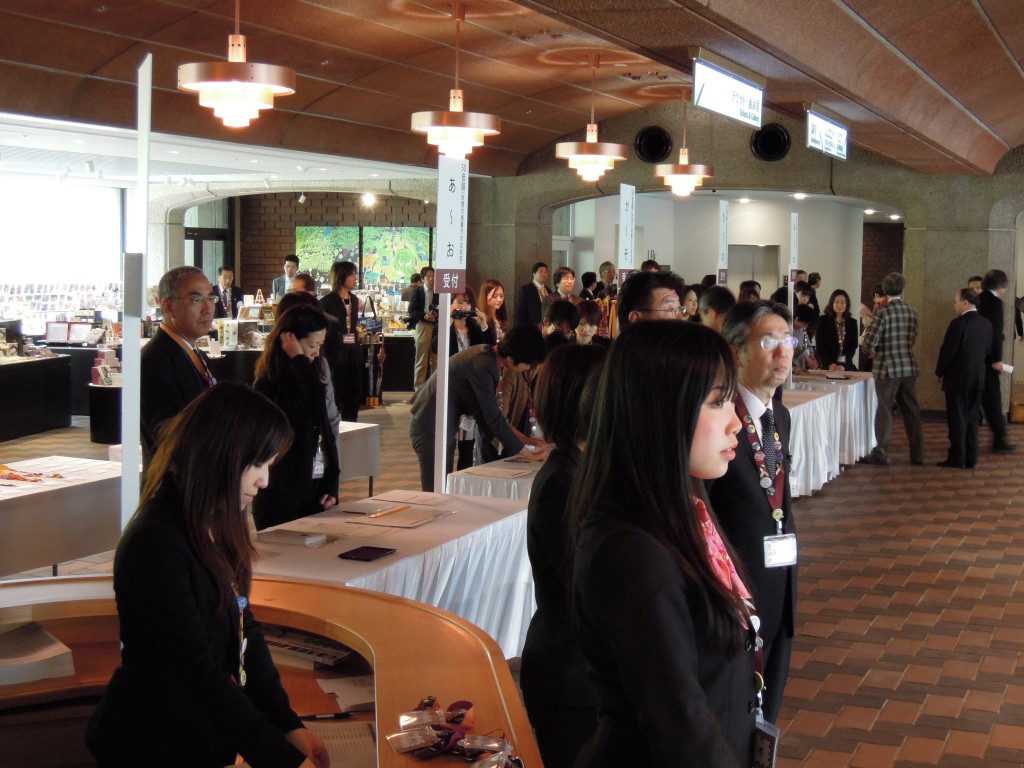
The Tokyo Metropolitan Art Museum Renovation Memorial Ceremony was held. The TOBIRA candidates stood with the Memorial Ceremony staff in the reception area and handed out art connectors (for details, please refer to the April 14, 2012 posting) to all those in attendance.
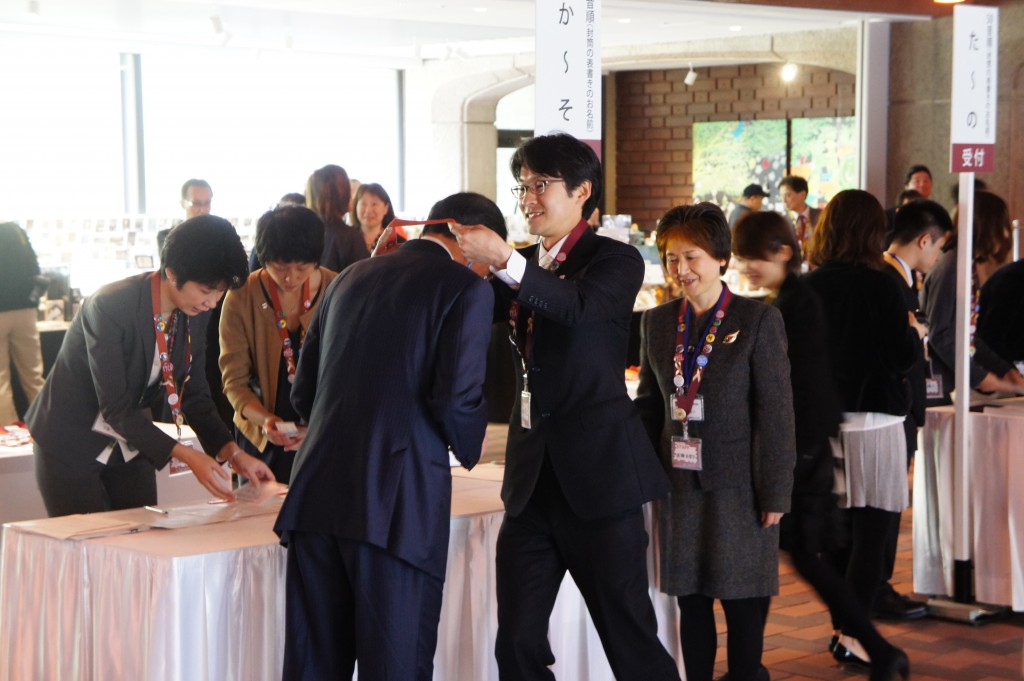
The TOBIRA candidates put art connectors around each person’s neck. There were some who felt a little uncomfortable, but everyone wore the art connectors cheerfully.
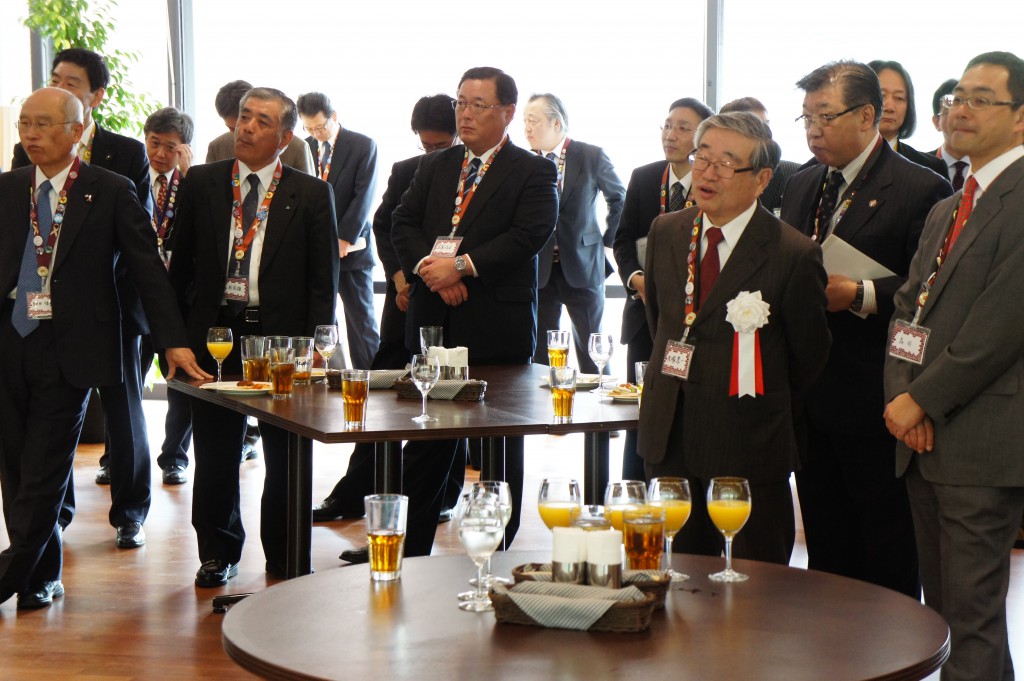
During the Ceremony and the party afterwards, everyone participated wearing their art connectors. The communication that arises from everyone putting on the same thing and sharing the same space is relaxing even amidst the glitz. It was a very pleasant time.
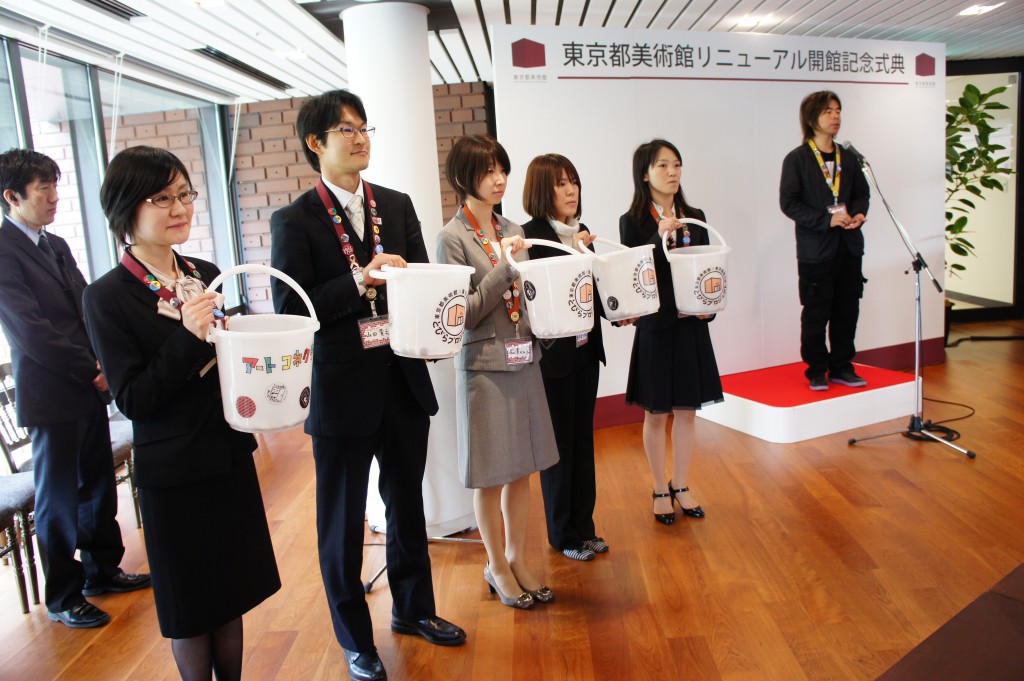
At the party, Katsuhiko Hibino explained the art connectors and talked about the activities of the TOBIRA Project going forward. What’s more, the TOBIRA candidates appeared carrying buckets. Inside were four types of additional rare pins.
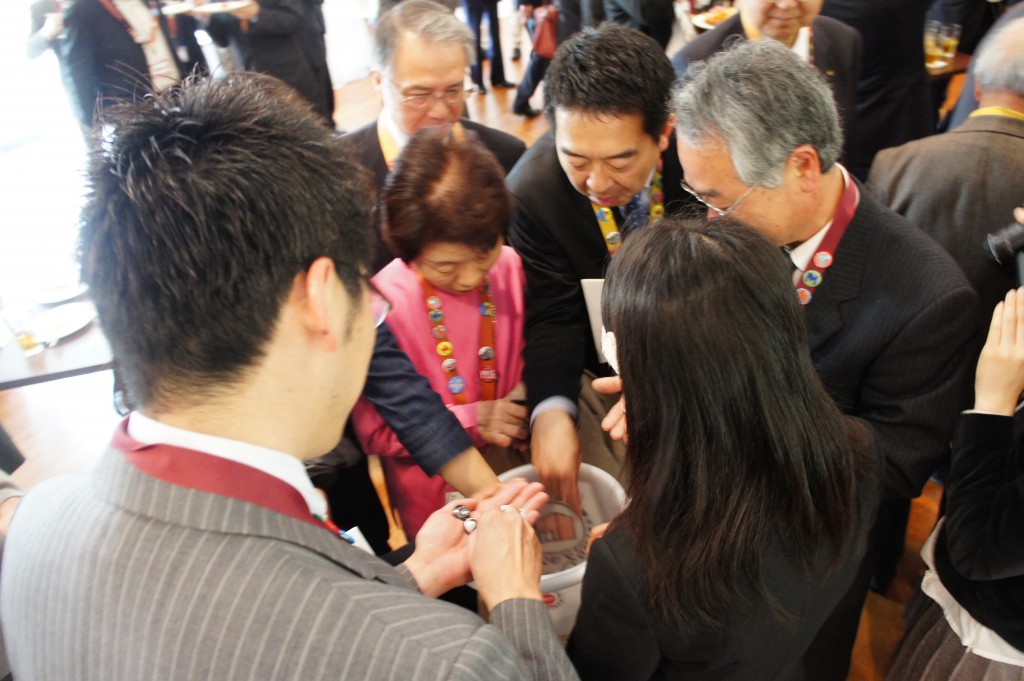
The TOBIRA candidates had great success when they took the buckets with the rare pins inside and distributed them to everyone. The pins generated many conversations.
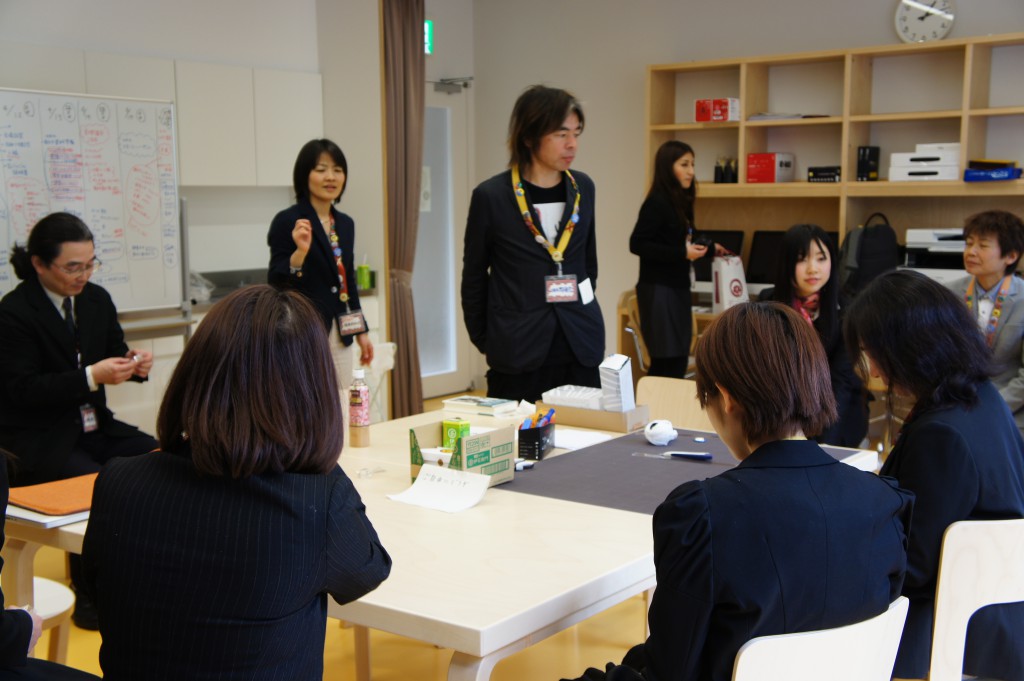
After the Memorial Ceremony, we had a quick review meeting with Katsuhiko Hibino in the project room. With a little creativity, there was a slight change in awareness. This resulted in a valuable experience that generated significant communication. TOBIRAs, you did an excellent job at your first big task! (Itō)
とびらプロジェクトってなに?
活動紹介
アーカイブ
お知らせ・募集
インタビュー

〒110-0007
東京都台東区上野公園8-36
東京都美術館交流棟2F プロジェクトルーム
TEL : 03-3823-6921(東京都美術館 代表)
メールアドレス : q-tobira (at) tobira-project.info
(at)を@にしてメールを送信してください。


Copyright © とびらプロジェクト2023. All rights reserved.